Saturday, April 01, 2006


April Fool
April, 2006: My 35th year, year five of the poetry month escapades, the job, the current residence and the relationship. Eight years since I gave up the musical pursuits for more lucrative ones and 14 since I finished structured study. It's 18 years (half a lifetime) that I've been living in a place I'd only meant to stay in for four. To what end?
The Conundrum of the Workshops
WHEN the flush of a newborn sun fell first on Eden's green and gold,
Our father Adam sat under the Tree and scratched with a stick in the mold;
And the first rude sketch that the world had seen was joy to his mighty heart,
Til the Devil whispered behind the leaves: "It's pretty, but is it Art?"
Wherefore he called to his wife and fled to fashion his work anew—
The first of his race who cared a fig for the first, most dread review;
And he left his lore to the use of his sons—and that was a glorious gain
When the Devil chuckled: "Is it Art?" in the ear of the branded Cain.
They builded a tower to shiver the sky and wrench the stars apart,
Till the Devil grunted behind the bricks: "It's striking, but is it Art?"
The stone was dropped by the quarry-side, and the idle derrick swung,
While each man talked of the aims of art, and each in an alien tongue.
They fought and they talked in the north and the south, they talked and they fought in the west,
Till the waters rose on the jabbering land, and the poor Red Clay had rest—
Had rest till the dank blank-canvas dawn when the dove was preened to start,
And the Devil bubbled below the keel: "It's human, but is it Art?"
The tale is old as the Eden Tree—as new as the new-cut tooth—
For each man knows ere his lip-thatch grows he is master of Art and Truth;
And each man hears as the twilight nears, to the beat of his dying heart,
The Devil drum on the darkened pane: "You did it, but was it Art?"
We have learned to whittle the Eden Tree to the shape of a surplice-peg,
We have learned to bottle our parents twain in the yolk of an addled egg,
We know that the tail must wag the dog, as the horse is drawn by the cart;
But the Devil whoops, as he whooped of old: "It's clever, but is it Art?"
When the flicker of London's sun falls faint on the club-room's green and gold,
The sons of Adam sit them down and scratch with their pens in the mold—
They scratch with their pens in the mold of their graves, and the ink and the anguish start
When the Devil mutters behind the leaves: "It's pretty, but is it art?"
Now, if we could win to the Eden Tree where the four great rivers flow,
And the wreath of Eve is red on the turf as she left it long ago,
And if we could come when the sentry slept, and softly scurry through,
By the favor of God we might know as much—as our father Adam knew.
-Rudyard Kipling
This also comes to mind:
L'Horloge
Horloge! dieu sinistre, effrayant, impassible,
Dont le doigt nous menace et nous dit: «Souviens-toi!
Les vibrantes Douleurs dans ton coeur plein d'effroi
Se planteront bientôt comme dans une cible;
Le Plaisir vaporeux fuira vers l'horizon
Ainsi qu'une sylphide au fond de la coulisse;
Chaque instant te dévore un morceau du délice
À chaque homme accordé pour toute sa saison.
Trois mille six cents fois par heure, la Seconde
Chuchote: Souviens-toi! — Rapide, avec sa voix
D'insecte, Maintenant dit: Je suis Autrefois,
Et j'ai pompé ta vie avec ma trompe immonde!
Remember! Souviens-toi! prodigue! Esto memor!
(Mon gosier de métal parle toutes les langues.)
Les minutes, mortel folâtre, sont des gangues
Qu'il ne faut pas lâcher sans en extraire l'or!
Souviens-toi que le Temps est un joueur avide
Qui gagne sans tricher, à tout coup! c'est la loi.
Le jour décroît; la nuit augmente; Souviens-toi!
Le gouffre a toujours soif; la clepsydre se vide.
Tantôt sonnera l'heure où le divin Hasard,
Où l'auguste Vertu, ton épouse encor vierge,
Où le Repentir même (oh! la dernière auberge!),
Où tout te dira Meurs, vieux lâche! il est trop tard!»
-Charles Baudelaire
Why such darkness at the beginning of spring? Why all this self-questioning? I guess because with spring comes flight, and I never took wing like so many others did. I find myself frozen and aging in a city that's perpetually young; unable to move forward as I'm always questioning the footsteps and weighing one expert opinion against another conflicting one.
April, 2006: My 35th year, year five of the poetry month escapades, the job, the current residence and the relationship. Eight years since I gave up the musical pursuits for more lucrative ones and 14 since I finished structured study. It's 18 years (half a lifetime) that I've been living in a place I'd only meant to stay in for four. To what end?
The Conundrum of the Workshops
WHEN the flush of a newborn sun fell first on Eden's green and gold,
Our father Adam sat under the Tree and scratched with a stick in the mold;
And the first rude sketch that the world had seen was joy to his mighty heart,
Til the Devil whispered behind the leaves: "It's pretty, but is it Art?"
Wherefore he called to his wife and fled to fashion his work anew—
The first of his race who cared a fig for the first, most dread review;
And he left his lore to the use of his sons—and that was a glorious gain
When the Devil chuckled: "Is it Art?" in the ear of the branded Cain.
They builded a tower to shiver the sky and wrench the stars apart,
Till the Devil grunted behind the bricks: "It's striking, but is it Art?"
The stone was dropped by the quarry-side, and the idle derrick swung,
While each man talked of the aims of art, and each in an alien tongue.
They fought and they talked in the north and the south, they talked and they fought in the west,
Till the waters rose on the jabbering land, and the poor Red Clay had rest—
Had rest till the dank blank-canvas dawn when the dove was preened to start,
And the Devil bubbled below the keel: "It's human, but is it Art?"
The tale is old as the Eden Tree—as new as the new-cut tooth—
For each man knows ere his lip-thatch grows he is master of Art and Truth;
And each man hears as the twilight nears, to the beat of his dying heart,
The Devil drum on the darkened pane: "You did it, but was it Art?"
We have learned to whittle the Eden Tree to the shape of a surplice-peg,
We have learned to bottle our parents twain in the yolk of an addled egg,
We know that the tail must wag the dog, as the horse is drawn by the cart;
But the Devil whoops, as he whooped of old: "It's clever, but is it Art?"
When the flicker of London's sun falls faint on the club-room's green and gold,
The sons of Adam sit them down and scratch with their pens in the mold—
They scratch with their pens in the mold of their graves, and the ink and the anguish start
When the Devil mutters behind the leaves: "It's pretty, but is it art?"
Now, if we could win to the Eden Tree where the four great rivers flow,
And the wreath of Eve is red on the turf as she left it long ago,
And if we could come when the sentry slept, and softly scurry through,
By the favor of God we might know as much—as our father Adam knew.
-Rudyard Kipling
This also comes to mind:
L'Horloge
Horloge! dieu sinistre, effrayant, impassible,
Dont le doigt nous menace et nous dit: «Souviens-toi!
Les vibrantes Douleurs dans ton coeur plein d'effroi
Se planteront bientôt comme dans une cible;
Le Plaisir vaporeux fuira vers l'horizon
Ainsi qu'une sylphide au fond de la coulisse;
Chaque instant te dévore un morceau du délice
À chaque homme accordé pour toute sa saison.
Trois mille six cents fois par heure, la Seconde
Chuchote: Souviens-toi! — Rapide, avec sa voix
D'insecte, Maintenant dit: Je suis Autrefois,
Et j'ai pompé ta vie avec ma trompe immonde!
Remember! Souviens-toi! prodigue! Esto memor!
(Mon gosier de métal parle toutes les langues.)
Les minutes, mortel folâtre, sont des gangues
Qu'il ne faut pas lâcher sans en extraire l'or!
Souviens-toi que le Temps est un joueur avide
Qui gagne sans tricher, à tout coup! c'est la loi.
Le jour décroît; la nuit augmente; Souviens-toi!
Le gouffre a toujours soif; la clepsydre se vide.
Tantôt sonnera l'heure où le divin Hasard,
Où l'auguste Vertu, ton épouse encor vierge,
Où le Repentir même (oh! la dernière auberge!),
Où tout te dira Meurs, vieux lâche! il est trop tard!»
-Charles Baudelaire
Why such darkness at the beginning of spring? Why all this self-questioning? I guess because with spring comes flight, and I never took wing like so many others did. I find myself frozen and aging in a city that's perpetually young; unable to move forward as I'm always questioning the footsteps and weighing one expert opinion against another conflicting one.
Friday, April 29, 2005
Thank you to Harold for this:
A New England poet often referred to as "the American Wordsworth".
"The world in which Bryant was at home is neither the dizzy mountainous terrain of Emerson nor the haunted midnight landscape of Poe. But, though it may never be a dazzling or romantic domain, after turbulent days we are glad for its quiet assurance. It may not be enchanted ground, but it has the comfort of good earth: it is sure haven."
Louis Untermeyer, Editor's Introduction,
The Poems of William Culllen Bryant,
Limited Editions Club, New York, NY, c.1947.
Inscription for the Entrance to a Wood
Stranger, if thou hast learned a truth which needs
No school of long experience, that the world
Is full of guilt and misery, and hast seen
Enough of all its sorrows, crimes, and cares,
To tire thee of it, enter this wild wood
And view the haunts of nature. The calm shade
Shall bring a kindred calm, and the sweet breeze
That makes the green leaves dance, shall waft a balm
To thy sick heart. Thou wilt find nothing here
Of all that pained thee in the haunts of men,
And made thee loathe thy life. The primal curse
Fell, it is true, upon the unsinning earth,
But not in vengance. God hath yoked to guilt
Her pale tormentor, Misery. Hence these shades
Are still the abode of gladness; the thick roof
Of green and stirring branches is alive
And musical with birds, that sing and sport
In wantonness of spirit; while below
The squirrel, with raised paws and form erect,
Chirps merrily. Throngs of insects in the shade
Try their thin wings and dance in the warm beam.
That waked them into life. Even the green trees
Partake the deep contentment; as they bend
To the soft winds, the sun from the blue sky
Looks in and sheds a blessing on the scene.
Scarce less the cleft-born wildflower seems to enjoy
Existence, than the winged plunderer
That sucks its sweets. The mossy rocks themselves,
And the old and ponderous trunks of prostrate trees
That lead from knoll to knoll a causeway rude,
Or bridge the sunken brook, and their dark roots,
With all their roots upon them, twisting high,
Breathe fixed tranquility. The rivulet
Sends forth glad sounds, and tripping o'er its bed
Of pebbly sands, or leaping down the rocks
Seems, with continuous laughter, to rejoice
In its own being. Softly tread the marge,
Lest from her midway perch thou scare the wren
That dips her bill in water. The cool wind,
That stirs the stream in play, shall come to thee,
Like one that loves thee nor will let thee pass
Ungreeted, and shall give its light embrace.
-William Cullen Bryant
A New England poet often referred to as "the American Wordsworth".
"The world in which Bryant was at home is neither the dizzy mountainous terrain of Emerson nor the haunted midnight landscape of Poe. But, though it may never be a dazzling or romantic domain, after turbulent days we are glad for its quiet assurance. It may not be enchanted ground, but it has the comfort of good earth: it is sure haven."
Louis Untermeyer, Editor's Introduction,
The Poems of William Culllen Bryant,
Limited Editions Club, New York, NY, c.1947.
Inscription for the Entrance to a Wood
Stranger, if thou hast learned a truth which needs
No school of long experience, that the world
Is full of guilt and misery, and hast seen
Enough of all its sorrows, crimes, and cares,
To tire thee of it, enter this wild wood
And view the haunts of nature. The calm shade
Shall bring a kindred calm, and the sweet breeze
That makes the green leaves dance, shall waft a balm
To thy sick heart. Thou wilt find nothing here
Of all that pained thee in the haunts of men,
And made thee loathe thy life. The primal curse
Fell, it is true, upon the unsinning earth,
But not in vengance. God hath yoked to guilt
Her pale tormentor, Misery. Hence these shades
Are still the abode of gladness; the thick roof
Of green and stirring branches is alive
And musical with birds, that sing and sport
In wantonness of spirit; while below
The squirrel, with raised paws and form erect,
Chirps merrily. Throngs of insects in the shade
Try their thin wings and dance in the warm beam.
That waked them into life. Even the green trees
Partake the deep contentment; as they bend
To the soft winds, the sun from the blue sky
Looks in and sheds a blessing on the scene.
Scarce less the cleft-born wildflower seems to enjoy
Existence, than the winged plunderer
That sucks its sweets. The mossy rocks themselves,
And the old and ponderous trunks of prostrate trees
That lead from knoll to knoll a causeway rude,
Or bridge the sunken brook, and their dark roots,
With all their roots upon them, twisting high,
Breathe fixed tranquility. The rivulet
Sends forth glad sounds, and tripping o'er its bed
Of pebbly sands, or leaping down the rocks
Seems, with continuous laughter, to rejoice
In its own being. Softly tread the marge,
Lest from her midway perch thou scare the wren
That dips her bill in water. The cool wind,
That stirs the stream in play, shall come to thee,
Like one that loves thee nor will let thee pass
Ungreeted, and shall give its light embrace.
-William Cullen Bryant
Thursday, April 28, 2005
I remember years ago, my friend Pavel reciting this poem to a Russian friend of mine who was a huge fan of poetry and Yevtushenko's work in particular. She was amazed to be talking about a long dormant love in her native tongue in her new home. I remember crying over the swan song of the lost brother. Anyway, let me leave the word to Pavel:
I found it by Googling the remembered refrain “dove-gray brother”. The Cyrillic didn’t appear correctly in my browser – it came out as a lot of funny accented Roman letters – until I fixed that by right-clicking in Windows Explorer and choosing Cyrillic under Encoding.
I heard Yevgeny Yevtushenko recite some of his poems at Princeton, in 1985 or 86 I think (my freshman year). He delivered some in English, others in Russian (these preceded by readings of the translations by a certain literature professor, from Queens College as I recall, who accompanied him on stage.) Yevtushenko was quite charismatic and expressive, even if you didn’t know the language. (It helped to have been told the content first.)
LAMENT FOR A BROTHER
To V. Shchukin
With blood still dripping from its
warm and sticky beak,
its neck dangling over a bucket's edge,
a goose lies rocking in a boat,
like an ingot
of slightly tarnished silver.
There had been two of them flying
above the river Vilyui.
The first had been brought down in flight
while the other,
gliding low,
risking his neck,
hovers over the boat,
cries over the forest:
"My dove-gray brother,
we came into the world
clamorously breaking through our shells,
but every morning
Mother and Father
fed you first,
when it might have been me.
My dove-gray brother,
you had this blue tinge,
teasing the sky with a bold similarity.
I was darker,
and the females desired
you more,
when it might have been me.
My dove-gray brother,
without fear for the return,
you and I flew away, over the seas,
but obnoxious geese from other lands surrounded
you first,
when it might have been me.
My dove-gray brother,
we were beaten and bowed.
Together we were lashed by the tempests,
but for some reason the water slid
more easily off your goose's back
when it might have been mine.
My dove-gray brother,
we frayed out feathers.
People will eat both of us by the fireside -
perhaps because
the struggle to be first
devoured you,
consumed me.
My dove-gray brother,
half our lives was a pecking match,
not treasuring our brotherhood, our wings, and our souls.
Was reliance really impossible -
I on you,
and you on me?
My dove-gray brother,
I beg at least for a pellet,
curbing my envy too late;
but for my punishment people killed
you first,
when it might have been me..."
1974
Translated by Arthur Boyars and Simon Franklin
This poem struck me particularly. He explained in English, before the English translation and his Russian recitation, that it was inspired by the event that made him gave up hunting. Once he killed a beautiful goose with unusual, striking bluish-grey plumage, and after that another goose flew overhead and cried. His imagination supplied the rest of the sad story of jealousy and regrets, and the poem.
Here is a transliteration, so you can have some sense of the dactylic meter and rhyme of the original. Also “you” and “me,” so often repeated, provide an internal rhyme in many lines. (Or at least have an assonance, “tebya” and “menya”). So I think it would better translate using “thee” and “me,” despite the spurious archaism in English. I suppose you will challenge me to make my own complete rhyming translation.
By the way, the Russian for “goose” happens to be “gus’” transliterated and almost the same pronounced! (Just palatalize the s.)
PLACH PO BRATU
S krov’yu iz klyuva, tyopel i lipok,
Sheyey motaya po krayu vedra,
V lodke kachayetsya gus’ budto slitok
Chut’ chernovatovo serebra.
Dvoye leteli oni vdol’ Vilyuya.
Pervyy ulozhen byl vlyot, a drugoy,
Nizko letya, golovoyu riskuya,
Kruzhit nad lodkoy, krichit nad taygoy:
“Sizyy moy brat, poyavilis’ my v mire,
Gromko svoyu skorlupu prolomya,
No po utram tebya pervym kormili
Mat’ i otets, a mogli by – menya.
Sizyy moy brat, ty byl chutochku sinii,
Nebo pokhozhest’yu derzkoy draznya,
Ya byl temnei, i lyubili gusyni
Bol’she – tebya, a mogli by – menya.
Sizyy moy brat, vozvrashchat’sya ne trusya,
My uleteli s toboy za morya,
No obstupali zamorskiye gusy
Pervym – tebya, a mogli by – menya.
Sizyy moy brat, my i bity i gnuty,
Vmeste nas livny khlestali klhest’mya,
Tol’ko skhodila voda pochemu-to
Legche s tebya, a mogla by – s menya.
Sizyy moy brat, istrepali my per’ya.
Lyudi s’’yedyat nas dvoikh u ognya.
Ne potomy l’, chto stremleniye byt’ pervym
Yelo tebya, pozhiralo menya?
Sizyy moy brat, my klevalis’ polzhizni,
Bratstva, i kryl’yev, i dush ne tsenya.
Razve nel’zya bylo nam polozhit’sya,
Mne – na tebya, a tebe – na menya?
Sizyy moy brat, ya proshu khot’ drobiny,
Zavist’ moyu zapozdalo klyanya,
No v nakazan’ye mne lyudi ubili
Pervym – tebya, a mogli by – menya.
I found it by Googling the remembered refrain “dove-gray brother”. The Cyrillic didn’t appear correctly in my browser – it came out as a lot of funny accented Roman letters – until I fixed that by right-clicking in Windows Explorer and choosing Cyrillic under Encoding.
I heard Yevgeny Yevtushenko recite some of his poems at Princeton, in 1985 or 86 I think (my freshman year). He delivered some in English, others in Russian (these preceded by readings of the translations by a certain literature professor, from Queens College as I recall, who accompanied him on stage.) Yevtushenko was quite charismatic and expressive, even if you didn’t know the language. (It helped to have been told the content first.)
LAMENT FOR A BROTHER
To V. Shchukin
With blood still dripping from its
warm and sticky beak,
its neck dangling over a bucket's edge,
a goose lies rocking in a boat,
like an ingot
of slightly tarnished silver.
There had been two of them flying
above the river Vilyui.
The first had been brought down in flight
while the other,
gliding low,
risking his neck,
hovers over the boat,
cries over the forest:
"My dove-gray brother,
we came into the world
clamorously breaking through our shells,
but every morning
Mother and Father
fed you first,
when it might have been me.
My dove-gray brother,
you had this blue tinge,
teasing the sky with a bold similarity.
I was darker,
and the females desired
you more,
when it might have been me.
My dove-gray brother,
without fear for the return,
you and I flew away, over the seas,
but obnoxious geese from other lands surrounded
you first,
when it might have been me.
My dove-gray brother,
we were beaten and bowed.
Together we were lashed by the tempests,
but for some reason the water slid
more easily off your goose's back
when it might have been mine.
My dove-gray brother,
we frayed out feathers.
People will eat both of us by the fireside -
perhaps because
the struggle to be first
devoured you,
consumed me.
My dove-gray brother,
half our lives was a pecking match,
not treasuring our brotherhood, our wings, and our souls.
Was reliance really impossible -
I on you,
and you on me?
My dove-gray brother,
I beg at least for a pellet,
curbing my envy too late;
but for my punishment people killed
you first,
when it might have been me..."
1974
Translated by Arthur Boyars and Simon Franklin
This poem struck me particularly. He explained in English, before the English translation and his Russian recitation, that it was inspired by the event that made him gave up hunting. Once he killed a beautiful goose with unusual, striking bluish-grey plumage, and after that another goose flew overhead and cried. His imagination supplied the rest of the sad story of jealousy and regrets, and the poem.
Here is a transliteration, so you can have some sense of the dactylic meter and rhyme of the original. Also “you” and “me,” so often repeated, provide an internal rhyme in many lines. (Or at least have an assonance, “tebya” and “menya”). So I think it would better translate using “thee” and “me,” despite the spurious archaism in English. I suppose you will challenge me to make my own complete rhyming translation.
By the way, the Russian for “goose” happens to be “gus’” transliterated and almost the same pronounced! (Just palatalize the s.)
PLACH PO BRATU
S krov’yu iz klyuva, tyopel i lipok,
Sheyey motaya po krayu vedra,
V lodke kachayetsya gus’ budto slitok
Chut’ chernovatovo serebra.
Dvoye leteli oni vdol’ Vilyuya.
Pervyy ulozhen byl vlyot, a drugoy,
Nizko letya, golovoyu riskuya,
Kruzhit nad lodkoy, krichit nad taygoy:
“Sizyy moy brat, poyavilis’ my v mire,
Gromko svoyu skorlupu prolomya,
No po utram tebya pervym kormili
Mat’ i otets, a mogli by – menya.
Sizyy moy brat, ty byl chutochku sinii,
Nebo pokhozhest’yu derzkoy draznya,
Ya byl temnei, i lyubili gusyni
Bol’she – tebya, a mogli by – menya.
Sizyy moy brat, vozvrashchat’sya ne trusya,
My uleteli s toboy za morya,
No obstupali zamorskiye gusy
Pervym – tebya, a mogli by – menya.
Sizyy moy brat, my i bity i gnuty,
Vmeste nas livny khlestali klhest’mya,
Tol’ko skhodila voda pochemu-to
Legche s tebya, a mogla by – s menya.
Sizyy moy brat, istrepali my per’ya.
Lyudi s’’yedyat nas dvoikh u ognya.
Ne potomy l’, chto stremleniye byt’ pervym
Yelo tebya, pozhiralo menya?
Sizyy moy brat, my klevalis’ polzhizni,
Bratstva, i kryl’yev, i dush ne tsenya.
Razve nel’zya bylo nam polozhit’sya,
Mne – na tebya, a tebe – na menya?
Sizyy moy brat, ya proshu khot’ drobiny,
Zavist’ moyu zapozdalo klyanya,
No v nakazan’ye mne lyudi ubili
Pervym – tebya, a mogli by – menya.
Wednesday, April 27, 2005
Dale sent me some other works by W H Auden:
I was going to send you a couple of Auden favorites, but I see you've
already put him up, so if this is now only for your private pleasure,
so be it. The Yeats poem is well known. I believe the poem "The
Geography of the House" originally came from a book of the same name
of poems about rooms in a house; the phrase itself is also a British
euphemism, and I suppose few could describe the inelegant so
elegantly, or love so wistfully.
In Memory Of W.B. Yeats
He disappeared in the dead of winter:
The brooks were frozen, the airports almost deserted,
The snow disfigured the public statues;
The mercury sank in the mouth of the dying day.
What instruments we have agree
The day of his death was a dark cold day.
Far from his illness
The wolves ran on through the evergreen forests,
The peasant river was untempted by the fashionable quays;
By mourning tongues
The death of the poet was kept from his poems.
But for him it was his last afternoon as himself,
An afternoon of nurses and rumours;
The provinces of his body revolted,
The squares of his mind were empty,
Silence invaded the suburbs,
The current of his feeling failed; he became his admirers.
Now he is scattered among a hundred cities
And wholly given over to unfamiliar affections,
To find his happiness in another kind of wood
And be punished under a foreign code of conscience.
The words of a dead man
Are modified in the guts of the living.
But in the importance and noise of to-morrow
When the brokers are roaring like beasts on the floor of the Bourse,
And the poor have the sufferings to which they are fairly accustomed,
And each in the cell of himself is almost convinced of his freedom,
A few thousand will think of this day
As one thinks of a day when one did something slightly unusual.
What instruments we have agree
The day of his death was a dark cold day.
II
You were silly like us; your gift survived it all:
The parish of rich women, physical decay,
Yourself. Mad Ireland hurt you into poetry.
Now Ireland has her madness and her weather still,
For poetry makes nothing happen: it survives
In the valley of its making where executives
Would never want to tamper, flows on south
From ranches of isolation and the busy griefs,
Raw towns that we believe and die in; it survives,
A way of happening, a mouth.
III
Earth, receive an honoured guest:
William Yeats is laid to rest.
Let the Irish vessel lie
Emptied of its poetry.
In the nightmare of the dark
All the dogs of Europe bark,
And the living nations wait,
Each sequestered in its hate;
Intellectual disgrace
Stares from every human face,
And the seas of pity lie
Locked and frozen in each eye.
Follow, poet, follow right
To the bottom of the night,
With your unconstraining voice
Still persuade us to rejoice.
With the farming of a verse
Make a vineyard of the curse,
Sing of human unsuccess
In a rapture of distress.
In the deserts of the heart
Let the healing fountains start,
In the prison of his days
Teach the free man how to praise.
W H Auden
The Geography of the House
(for Christopher Isherwood)
Seated after breakfast
In this white-tiled cabin
Arabs call the House where
Everybody goes,
Even melancholics
Raise a cheer to Mrs.
Nature for the primal
Pleasure She bestows.
Sex is but a dream to
Seventy-and-over,
But a joy proposed un-
-til we start to shave:
Mouth-delight depends on
Virtue in the cook, but
This She guarantees from
Cradle unto grave.
Lifted off the potty,
Infants from their mothers
Hear their first impartial
Words of worldly praise:
Hence, to start the morning
With a satisfactory
Dump is a good omen
All our adult days.
Revelation came to
Luther in a privy
(Crosswords have been solved there)
Rodin was no fool
When he cast his Thinker,
Cogitating deeply,
Crouched in the position
Of a man at stool.
All the arts derive from
This ur-act of making,
Private to the artist:
Makers' lives are spent
Striving in their chosen
Medium to produce a
De-narcissus-ized en-
During excrement.
Freud did not invent the
Constipated miser:
Banks have letter boxes
Built in their façade
Marked For Night Deposits,
Stocks are firm or liquid,
Currencies of nations
Either soft or hard.
Global Mother, keep our
Bowels of compassion
Open through our lifetime,
Purge our minds as well:
Grant us a king ending,
Not a second childhood,
Petulant, weak-sphinctered,
In a cheap hotel.
Keep us in our station:
When we get pound-notish,
When we seem about to
Take up Higher Thought,
Send us some deflating
Image like the pained ex-
-pression on a Major
Prophet taken short.
(Orthodoxy ought to
Bless our modern plumbing:
Swift and St. Augustine
Lived in centuries
When a stench of sewage
Made a strong debating
Point for Manichees.)
Mind and Body run on
Different timetables:
Not until our morning
Visit here can we
Leave the dead concerns of
Yesterday behind us,
Face with all our courage
What is now to be.
W H Auden
O Tell Me The Truth About Love
Some say love's a little boy,
And some say it's a bird,
Some say it makes the world go around,
Some say that's absurd,
And when I asked the man next-door,
Who looked as if he knew,
His wife got very cross indeed,
And said it wouldn't do.
Does it look like a pair of pyjamas,
Or the ham in a temperance hotel?
Does its odour remind one of llamas,
Or has it a comforting smell?
Is it prickly to touch as a hedge is,
Or soft as eiderdown fluff?
Is it sharp or quite smooth at the edges?
O tell me the truth about love.
Our history books refer to it
In cryptic little notes,
It's quite a common topic on
The Transatlantic boats;
I've found the subject mentioned in
Accounts of suicides,
And even seen it scribbled on
The backs of railway guides.
Does it howl like a hungry Alsatian,
Or boom like a military band?
Could one give a first-rate imitation
On a saw or a Steinway Grand?
Is its singing at parties a riot?
Does it only like Classical stuff?
Will it stop when one wants to be quiet?
O tell me the truth about love.
I looked inside the summer-house;
It wasn't over there;
I tried the Thames at Maidenhead,
And Brighton's bracing air.
I don't know what the blackbird sang,
Or what the tulip said;
But it wasn't in the chicken-run,
Or underneath the bed.
Can it pull extraordinary faces?
Is it usually sick on a swing?
Does it spend all its time at the races,
or fiddling with pieces of string?
Has it views of its own about money?
Does it think Patriotism enough?
Are its stories vulgar but funny?
O tell me the truth about love.
When it comes, will it come without warning
Just as I'm picking my nose?
Will it knock on my door in the morning,
Or tread in the bus on my toes?
Will it come like a change in the weather?
Will its greeting be courteous or rough?
Will it alter my life altogether?
O tell me the truth about love.
W H Auden
I was going to send you a couple of Auden favorites, but I see you've
already put him up, so if this is now only for your private pleasure,
so be it. The Yeats poem is well known. I believe the poem "The
Geography of the House" originally came from a book of the same name
of poems about rooms in a house; the phrase itself is also a British
euphemism, and I suppose few could describe the inelegant so
elegantly, or love so wistfully.
In Memory Of W.B. Yeats
He disappeared in the dead of winter:
The brooks were frozen, the airports almost deserted,
The snow disfigured the public statues;
The mercury sank in the mouth of the dying day.
What instruments we have agree
The day of his death was a dark cold day.
Far from his illness
The wolves ran on through the evergreen forests,
The peasant river was untempted by the fashionable quays;
By mourning tongues
The death of the poet was kept from his poems.
But for him it was his last afternoon as himself,
An afternoon of nurses and rumours;
The provinces of his body revolted,
The squares of his mind were empty,
Silence invaded the suburbs,
The current of his feeling failed; he became his admirers.
Now he is scattered among a hundred cities
And wholly given over to unfamiliar affections,
To find his happiness in another kind of wood
And be punished under a foreign code of conscience.
The words of a dead man
Are modified in the guts of the living.
But in the importance and noise of to-morrow
When the brokers are roaring like beasts on the floor of the Bourse,
And the poor have the sufferings to which they are fairly accustomed,
And each in the cell of himself is almost convinced of his freedom,
A few thousand will think of this day
As one thinks of a day when one did something slightly unusual.
What instruments we have agree
The day of his death was a dark cold day.
II
You were silly like us; your gift survived it all:
The parish of rich women, physical decay,
Yourself. Mad Ireland hurt you into poetry.
Now Ireland has her madness and her weather still,
For poetry makes nothing happen: it survives
In the valley of its making where executives
Would never want to tamper, flows on south
From ranches of isolation and the busy griefs,
Raw towns that we believe and die in; it survives,
A way of happening, a mouth.
III
Earth, receive an honoured guest:
William Yeats is laid to rest.
Let the Irish vessel lie
Emptied of its poetry.
In the nightmare of the dark
All the dogs of Europe bark,
And the living nations wait,
Each sequestered in its hate;
Intellectual disgrace
Stares from every human face,
And the seas of pity lie
Locked and frozen in each eye.
Follow, poet, follow right
To the bottom of the night,
With your unconstraining voice
Still persuade us to rejoice.
With the farming of a verse
Make a vineyard of the curse,
Sing of human unsuccess
In a rapture of distress.
In the deserts of the heart
Let the healing fountains start,
In the prison of his days
Teach the free man how to praise.
W H Auden
The Geography of the House
(for Christopher Isherwood)
Seated after breakfast
In this white-tiled cabin
Arabs call the House where
Everybody goes,
Even melancholics
Raise a cheer to Mrs.
Nature for the primal
Pleasure She bestows.
Sex is but a dream to
Seventy-and-over,
But a joy proposed un-
-til we start to shave:
Mouth-delight depends on
Virtue in the cook, but
This She guarantees from
Cradle unto grave.
Lifted off the potty,
Infants from their mothers
Hear their first impartial
Words of worldly praise:
Hence, to start the morning
With a satisfactory
Dump is a good omen
All our adult days.
Revelation came to
Luther in a privy
(Crosswords have been solved there)
Rodin was no fool
When he cast his Thinker,
Cogitating deeply,
Crouched in the position
Of a man at stool.
All the arts derive from
This ur-act of making,
Private to the artist:
Makers' lives are spent
Striving in their chosen
Medium to produce a
De-narcissus-ized en-
During excrement.
Freud did not invent the
Constipated miser:
Banks have letter boxes
Built in their façade
Marked For Night Deposits,
Stocks are firm or liquid,
Currencies of nations
Either soft or hard.
Global Mother, keep our
Bowels of compassion
Open through our lifetime,
Purge our minds as well:
Grant us a king ending,
Not a second childhood,
Petulant, weak-sphinctered,
In a cheap hotel.
Keep us in our station:
When we get pound-notish,
When we seem about to
Take up Higher Thought,
Send us some deflating
Image like the pained ex-
-pression on a Major
Prophet taken short.
(Orthodoxy ought to
Bless our modern plumbing:
Swift and St. Augustine
Lived in centuries
When a stench of sewage
Made a strong debating
Point for Manichees.)
Mind and Body run on
Different timetables:
Not until our morning
Visit here can we
Leave the dead concerns of
Yesterday behind us,
Face with all our courage
What is now to be.
W H Auden
O Tell Me The Truth About Love
Some say love's a little boy,
And some say it's a bird,
Some say it makes the world go around,
Some say that's absurd,
And when I asked the man next-door,
Who looked as if he knew,
His wife got very cross indeed,
And said it wouldn't do.
Does it look like a pair of pyjamas,
Or the ham in a temperance hotel?
Does its odour remind one of llamas,
Or has it a comforting smell?
Is it prickly to touch as a hedge is,
Or soft as eiderdown fluff?
Is it sharp or quite smooth at the edges?
O tell me the truth about love.
Our history books refer to it
In cryptic little notes,
It's quite a common topic on
The Transatlantic boats;
I've found the subject mentioned in
Accounts of suicides,
And even seen it scribbled on
The backs of railway guides.
Does it howl like a hungry Alsatian,
Or boom like a military band?
Could one give a first-rate imitation
On a saw or a Steinway Grand?
Is its singing at parties a riot?
Does it only like Classical stuff?
Will it stop when one wants to be quiet?
O tell me the truth about love.
I looked inside the summer-house;
It wasn't over there;
I tried the Thames at Maidenhead,
And Brighton's bracing air.
I don't know what the blackbird sang,
Or what the tulip said;
But it wasn't in the chicken-run,
Or underneath the bed.
Can it pull extraordinary faces?
Is it usually sick on a swing?
Does it spend all its time at the races,
or fiddling with pieces of string?
Has it views of its own about money?
Does it think Patriotism enough?
Are its stories vulgar but funny?
O tell me the truth about love.
When it comes, will it come without warning
Just as I'm picking my nose?
Will it knock on my door in the morning,
Or tread in the bus on my toes?
Will it come like a change in the weather?
Will its greeting be courteous or rough?
Will it alter my life altogether?
O tell me the truth about love.
W H Auden
Tuesday, April 26, 2005
Pablo on his choice:
"Ronald Reagan borrowed phrases from the first and last lines when he eulogized the astronauts who died in the Space Shuttle. That must be the unremembered source of the phrase “surly bonds of earth” which was in my head and recurred to me while reading some of the early Lovecraft stories – like the ones with protagonist Randolph Carter -- which are more escapist fantasy than horror, treating of the dream-world travelers escaping from the mundane. But the poem itself is about the very real experience of an airplane pilot."
High Flight
Oh! I have slipped the surly bonds of Earth
And danced the skies on laughter-silvered wings;
Sunward I've climbed and joined the tumbling mirth of sun-split clouds,--and done a hundred things
You have not dreamed of wheeled and soared and swung
High in the sunlit silence. Hov'ring there,
I've chased the shouting wind along, and flung
My eager craft through footless falls of air...
Up, up the long, delirious, burning blue
I've topped the wind-swept heights with easy grace
Where never lark, nor eer eagle flew--
And, while with silent lifting mind I've trod
The high, untrespassed sanctity of space,
Put out my hand and touched the face of God
-John Gillespe Magee
"Ronald Reagan borrowed phrases from the first and last lines when he eulogized the astronauts who died in the Space Shuttle. That must be the unremembered source of the phrase “surly bonds of earth” which was in my head and recurred to me while reading some of the early Lovecraft stories – like the ones with protagonist Randolph Carter -- which are more escapist fantasy than horror, treating of the dream-world travelers escaping from the mundane. But the poem itself is about the very real experience of an airplane pilot."
High Flight
Oh! I have slipped the surly bonds of Earth
And danced the skies on laughter-silvered wings;
Sunward I've climbed and joined the tumbling mirth of sun-split clouds,--and done a hundred things
You have not dreamed of wheeled and soared and swung
High in the sunlit silence. Hov'ring there,
I've chased the shouting wind along, and flung
My eager craft through footless falls of air...
Up, up the long, delirious, burning blue
I've topped the wind-swept heights with easy grace
Where never lark, nor eer eagle flew--
And, while with silent lifting mind I've trod
The high, untrespassed sanctity of space,
Put out my hand and touched the face of God
-John Gillespe Magee
Monday, April 25, 2005
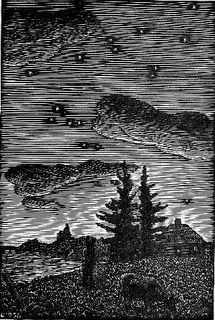
Let me leave today's word to Hal - New Englander, Printmaker, fan of J. J. Lankes:
***
Here are three poems my Maine author Robert P. Tristram Coffin, from
his collection "Saltwater Farm" (illustrated by JJ Lankes
incidentally). The poems have a regionalist or New England
sensibility about them, with references to working the earth, and a
keen perception of nature, much like in Lankes woodcuts.
THE FOG
He knew how Roman legions looked, for he
Had seen the Maine coast fogs march in from the sea
For many years now, in the August days.
They came in mighty columns up the bays,
Tawny and gray and silver in the sun;
They trampled out the seaports one by one,
The islands and the woods, with their high hosts,
And pushed the world back inland from the coasts.
This little house was lost, these hills and dells,
Cows in pasture faded into bells,
The world around a man closed in and in
Till nowhere was ten paces from this chin.
A man drew up and halted with a start
To be so close to his beating heart
And left so to himself and wholly blind
To everything but what was in his mind.
This was the peril and the comfort, too,
A man who lived in such a region knew;
On any Summer's day, within an hour,
He might be blind and naked to a power
So vast, it might have come from stars unmade,
Undreamt of, even, making him afraid,
So mightier than the night that he could guess
How life was but a name for loneliness.
FOOTSTEPS OF FLAME
His father had explained it all to him;
How rockweed in November at the rim
Of ebb tide showed a phosphorescent mark
When you stepped upon it in the dark.
That was all the story. Just the same,
The boy still thought the footprints were still a flame,
And he believed their feet must give out light,
Which made them show up plain there in the night.
You could not get around it. There they lay,
Footmarks you could see as plain as day
Coming up from behind as they walked,
The big ones and the little. While they talked
Of things of everyday, the steps came on,
There must be something to them so they shone.
It was simplest to believe 'twas so
And not trust things a small boy could not know.
That was the beginning. But it spread,
Until it got into the small boy's head
That always when his father was along
Something burned inside them that was strong
As sunlight, fierce and hot and clean,
Something very lovely though unseen,
And sometimes he had hard work no to stare
As though a wing had stirred his father's hair.
TAKING THE TURN
The best time on a farm is when
Sleep lies on the most of men.
It is when you rise and go
By starlight, through the dew or snow,
With your lantern by your side,
To see that all is right outside.
You take your turn to see all the housed;
The cows with velvet eyeballs drowsed.
The hens grown gentle as the dove,
Bunched all together in their love.
The utter peace of sleeping pigs,
Strange lacework of the maple twigs.
The fairy world that spiders spin
Along the corners of the bin.
The house's gable high with night,
Familiar things made strange by light.
Undulant beauty in a plow,
A pitchfork's shadow on the mow.
Wings out of homely things that soar
When your lanterns on the floor.
The shadow that a staple throws,
Hay chaff like an airy rose.
All is gentle, slow, and sure,
Peace behind each fastened door.
All is quiet, hunger done,
Peace beyond light of the sun.
***
Here are three poems my Maine author Robert P. Tristram Coffin, from
his collection "Saltwater Farm" (illustrated by JJ Lankes
incidentally). The poems have a regionalist or New England
sensibility about them, with references to working the earth, and a
keen perception of nature, much like in Lankes woodcuts.
THE FOG
He knew how Roman legions looked, for he
Had seen the Maine coast fogs march in from the sea
For many years now, in the August days.
They came in mighty columns up the bays,
Tawny and gray and silver in the sun;
They trampled out the seaports one by one,
The islands and the woods, with their high hosts,
And pushed the world back inland from the coasts.
This little house was lost, these hills and dells,
Cows in pasture faded into bells,
The world around a man closed in and in
Till nowhere was ten paces from this chin.
A man drew up and halted with a start
To be so close to his beating heart
And left so to himself and wholly blind
To everything but what was in his mind.
This was the peril and the comfort, too,
A man who lived in such a region knew;
On any Summer's day, within an hour,
He might be blind and naked to a power
So vast, it might have come from stars unmade,
Undreamt of, even, making him afraid,
So mightier than the night that he could guess
How life was but a name for loneliness.
FOOTSTEPS OF FLAME
His father had explained it all to him;
How rockweed in November at the rim
Of ebb tide showed a phosphorescent mark
When you stepped upon it in the dark.
That was all the story. Just the same,
The boy still thought the footprints were still a flame,
And he believed their feet must give out light,
Which made them show up plain there in the night.
You could not get around it. There they lay,
Footmarks you could see as plain as day
Coming up from behind as they walked,
The big ones and the little. While they talked
Of things of everyday, the steps came on,
There must be something to them so they shone.
It was simplest to believe 'twas so
And not trust things a small boy could not know.
That was the beginning. But it spread,
Until it got into the small boy's head
That always when his father was along
Something burned inside them that was strong
As sunlight, fierce and hot and clean,
Something very lovely though unseen,
And sometimes he had hard work no to stare
As though a wing had stirred his father's hair.
TAKING THE TURN
The best time on a farm is when
Sleep lies on the most of men.
It is when you rise and go
By starlight, through the dew or snow,
With your lantern by your side,
To see that all is right outside.
You take your turn to see all the housed;
The cows with velvet eyeballs drowsed.
The hens grown gentle as the dove,
Bunched all together in their love.
The utter peace of sleeping pigs,
Strange lacework of the maple twigs.
The fairy world that spiders spin
Along the corners of the bin.
The house's gable high with night,
Familiar things made strange by light.
Undulant beauty in a plow,
A pitchfork's shadow on the mow.
Wings out of homely things that soar
When your lanterns on the floor.
The shadow that a staple throws,
Hay chaff like an airy rose.
All is gentle, slow, and sure,
Peace behind each fastened door.
All is quiet, hunger done,
Peace beyond light of the sun.

Thursday, April 21, 2005
Chandrahas over at The Middle Stage introduced me to a Turkish poet by the name of Orhan Veli Kanik the other day:
ALL OF A SUDDEN
Everything happened all of a sudden.
All of a sudden daylight beat down on the earth;
There was the sky all of a sudden;
All of a sudden steam began to rise from the soil.
There were tendrils all of a sudden, buds all of a sudden.
And there were fruits all of a sudden.
All of a sudden,
All of a sudden,
Girls all of a sudden, boys all of a sudden.
Roads, moors, cats, people...
And there was love all of a sudden,
Happiness all of a sudden.
("All of a Sudden" makes me think of Neruda's poem "Spring" from Fully Empowered - the rebirth of everything due of the song of a bird.)
FREE
We live free
Air is free, clouds are free
Valleys and hills are free
Rain and mud are free
The outside of cars
The entrances of cinemas
And the shop windows are free
Bread and cheese cost money
But stale water is free
Freedom can cost your head
But prison is free
We live free
(Here is another work in a similar vein.)
IF ONLY I COULD SET SAIL
How pleasant, oh dear God, how pleasant
To journey on the blue sea
To cast off from shore
Aimless as thought.
I would set sail to the wind
And wander from sea to sea
To find myself one morning
In some deserted bay.
In a harbor large and clean
A harbor in coral isles
Where in the wake of clouds
A golden summer trails.
The languid scent of oleasters
Would fill me there
And the taste of sorrow
Never find that place.
Sparrows would nest in the flowered
Eaves of my dream castle
The evenings would unravel with colors
The days pass in pomengrate gardens.
Here are a few more poems in translation.
ALL OF A SUDDEN
Everything happened all of a sudden.
All of a sudden daylight beat down on the earth;
There was the sky all of a sudden;
All of a sudden steam began to rise from the soil.
There were tendrils all of a sudden, buds all of a sudden.
And there were fruits all of a sudden.
All of a sudden,
All of a sudden,
Girls all of a sudden, boys all of a sudden.
Roads, moors, cats, people...
And there was love all of a sudden,
Happiness all of a sudden.
("All of a Sudden" makes me think of Neruda's poem "Spring" from Fully Empowered - the rebirth of everything due of the song of a bird.)
FREE
We live free
Air is free, clouds are free
Valleys and hills are free
Rain and mud are free
The outside of cars
The entrances of cinemas
And the shop windows are free
Bread and cheese cost money
But stale water is free
Freedom can cost your head
But prison is free
We live free
(Here is another work in a similar vein.)
IF ONLY I COULD SET SAIL
How pleasant, oh dear God, how pleasant
To journey on the blue sea
To cast off from shore
Aimless as thought.
I would set sail to the wind
And wander from sea to sea
To find myself one morning
In some deserted bay.
In a harbor large and clean
A harbor in coral isles
Where in the wake of clouds
A golden summer trails.
The languid scent of oleasters
Would fill me there
And the taste of sorrow
Never find that place.
Sparrows would nest in the flowered
Eaves of my dream castle
The evenings would unravel with colors
The days pass in pomengrate gardens.
Here are a few more poems in translation.
Wednesday, April 20, 2005
Racist or the Casualty of Shallow Misinterpretation?
I. Stephen Collins Foster
A northerner and member of the abolitionist movement, Stephen Collins Foster sought to both reform minstrelsy (musical revues that caricatured blacks and mimicked them for comic effect) and, through his music, bring light to the plight of black people after Emancipation. His lyrics were in dialect (as was the fashion of the time), but with strict instructions to perform with sympathy.
Oh Susanna
Old Folks at Home (Swanee River)
Of course, much of this is considered racist nowadays, and his music has been struck off the curricula of many schools (not to mention publishers of his works threatened with boycotts). Judged with current standards, perhaps he was. Viewed in context, however, he is still an important contributor to American popular culture. If we weren't so sensitive about offending others, perhaps there could be constructive dialogue about the nature of his writing, the racial climate of the times, current interpretations.
I. Stephen Collins Foster
A northerner and member of the abolitionist movement, Stephen Collins Foster sought to both reform minstrelsy (musical revues that caricatured blacks and mimicked them for comic effect) and, through his music, bring light to the plight of black people after Emancipation. His lyrics were in dialect (as was the fashion of the time), but with strict instructions to perform with sympathy.
Oh Susanna
Old Folks at Home (Swanee River)
Of course, much of this is considered racist nowadays, and his music has been struck off the curricula of many schools (not to mention publishers of his works threatened with boycotts). Judged with current standards, perhaps he was. Viewed in context, however, he is still an important contributor to American popular culture. If we weren't so sensitive about offending others, perhaps there could be constructive dialogue about the nature of his writing, the racial climate of the times, current interpretations.
Tuesday, April 19, 2005
And how could we ever leave out this great ode?
Concord Hymn
By the rude bridge that arched the flood,
Their flag to April’s breeze unfurled,
Here once the embattled farmers stood,
And fired the shot heard round the world.
The foe long since in silence slept;
Alike the conqueror silent sleeps;
And Time the ruined bridge has swept
Down the dark stream which seaward creeps.
On this green bank, by this soft stream,
We set to-day a votive stone;
That memory may their deed redeem,
When, like our sires, our sons are gone.
Spirit, that made those heroes dare
To die, and leave their children free,
Bid Time and Nature gently spare
The shaft we raise to them and thee.
-Ralph Waldo Emerson
Concord Hymn
By the rude bridge that arched the flood,
Their flag to April’s breeze unfurled,
Here once the embattled farmers stood,
And fired the shot heard round the world.
The foe long since in silence slept;
Alike the conqueror silent sleeps;
And Time the ruined bridge has swept
Down the dark stream which seaward creeps.
On this green bank, by this soft stream,
We set to-day a votive stone;
That memory may their deed redeem,
When, like our sires, our sons are gone.
Spirit, that made those heroes dare
To die, and leave their children free,
Bid Time and Nature gently spare
The shaft we raise to them and thee.
-Ralph Waldo Emerson
Since today is Patriots Day, I think that some Longfellow might be in order:
Paul Revere's Ride
Listen my children and you shall hear
Of the midnight ride of Paul Revere,
On the eighteenth of April, in Seventy-five;
Hardly a man is now alive
Who remembers that famous day and year.
He said to his friend, "If the British march
By land or sea from the town to-night,
Hang a lantern aloft in the belfry arch
Of the North Church tower as a signal light,--
One if by land, and two if by sea;
And I on the opposite shore will be,
Ready to ride and spread the alarm
Through every Middlesex village and farm,
For the country folk to be up and to arm."
Then he said "Good-night!" and with muffled oar
Silently rowed to the Charlestown shore,
Just as the moon rose over the bay,
Where swinging wide at her moorings lay
The Somerset, British man-of-war;
A phantom ship, with each mast and spar
Across the moon like a prison bar,
And a huge black hulk, that was magnified
By its own reflection in the tide.
Meanwhile, his friend through alley and street
Wanders and watches, with eager ears,
Till in the silence around him he hears
The muster of men at the barrack door,
The sound of arms, and the tramp of feet,
And the measured tread of the grenadiers,
Marching down to their boats on the shore.
Then he climbed the tower of the Old North Church,
By the wooden stairs, with stealthy tread,
To the belfry chamber overhead,
And startled the pigeons from their perch
On the sombre rafters, that round him made
Masses and moving shapes of shade,--
By the trembling ladder, steep and tall,
To the highest window in the wall,
Where he paused to listen and look down
A moment on the roofs of the town
And the moonlight flowing over all.
Beneath, in the churchyard, lay the dead,
In their night encampment on the hill,
Wrapped in silence so deep and still
That he could hear, like a sentinel's tread,
The watchful night-wind, as it went
Creeping along from tent to tent,
And seeming to whisper, "All is well!"
A moment only he feels the spell
Of the place and the hour, and the secret dread
Of the lonely belfry and the dead;
For suddenly all his thoughts are bent
On a shadowy something far away,
Where the river widens to meet the bay,--
A line of black that bends and floats
On the rising tide like a bridge of boats.
Meanwhile, impatient to mount and ride,
Booted and spurred, with a heavy stride
On the opposite shore walked Paul Revere.
Now he patted his horse's side,
Now he gazed at the landscape far and near,
Then, impetuous, stamped the earth,
And turned and tightened his saddle girth;
But mostly he watched with eager search
The belfry tower of the Old North Church,
As it rose above the graves on the hill,
Lonely and spectral and sombre and still.
And lo! as he looks, on the belfry's height
A glimmer, and then a gleam of light!
He springs to the saddle, the bridle he turns,
But lingers and gazes, till full on his sight
A second lamp in the belfry burns.
A hurry of hoofs in a village street,
A shape in the moonlight, a bulk in the dark,
And beneath, from the pebbles, in passing, a spark
Struck out by a steed flying fearless and fleet;
That was all! And yet, through the gloom and the light,
The fate of a nation was riding that night;
And the spark struck out by that steed, in his flight,
Kindled the land into flame with its heat.
He has left the village and mounted the steep,
And beneath him, tranquil and broad and deep,
Is the Mystic, meeting the ocean tides;
And under the alders that skirt its edge,
Now soft on the sand, now loud on the ledge,
Is heard the tramp of his steed as he rides.
It was twelve by the village clock
When he crossed the bridge into Medford town.
He heard the crowing of the cock,
And the barking of the farmer's dog,
And felt the damp of the river fog,
That rises after the sun goes down.
It was one by the village clock,
When he galloped into Lexington.
He saw the gilded weathercock
Swim in the moonlight as he passed,
And the meeting-house windows, black and bare,
Gaze at him with a spectral glare,
As if they already stood aghast
At the bloody work they would look upon.
It was two by the village clock,
When he came to the bridge in Concord town.
He heard the bleating of the flock,
And the twitter of birds among the trees,
And felt the breath of the morning breeze
Blowing over the meadow brown.
And one was safe and asleep in his bed
Who at the bridge would be first to fall,
Who that day would be lying dead,
Pierced by a British musket ball.
You know the rest. In the books you have read
How the British Regulars fired and fled,---
How the farmers gave them ball for ball,
From behind each fence and farmyard wall,
Chasing the redcoats down the lane,
Then crossing the fields to emerge again
Under the trees at the turn of the road,
And only pausing to fire and load.
So through the night rode Paul Revere;
And so through the night went his cry of alarm
To every Middlesex village and farm,---
A cry of defiance, and not of fear,
A voice in the darkness, a knock at the door,
And a word that shall echo for evermore!
For, borne on the night-wind of the Past,
Through all our history, to the last,
In the hour of darkness and peril and need,
The people will waken and listen to hear
The hurrying hoof-beats of that steed,
And the midnight message of Paul Revere.
-Henry Wordsworth Longfellow
Paul Revere's Ride
Listen my children and you shall hear
Of the midnight ride of Paul Revere,
On the eighteenth of April, in Seventy-five;
Hardly a man is now alive
Who remembers that famous day and year.
He said to his friend, "If the British march
By land or sea from the town to-night,
Hang a lantern aloft in the belfry arch
Of the North Church tower as a signal light,--
One if by land, and two if by sea;
And I on the opposite shore will be,
Ready to ride and spread the alarm
Through every Middlesex village and farm,
For the country folk to be up and to arm."
Then he said "Good-night!" and with muffled oar
Silently rowed to the Charlestown shore,
Just as the moon rose over the bay,
Where swinging wide at her moorings lay
The Somerset, British man-of-war;
A phantom ship, with each mast and spar
Across the moon like a prison bar,
And a huge black hulk, that was magnified
By its own reflection in the tide.
Meanwhile, his friend through alley and street
Wanders and watches, with eager ears,
Till in the silence around him he hears
The muster of men at the barrack door,
The sound of arms, and the tramp of feet,
And the measured tread of the grenadiers,
Marching down to their boats on the shore.
Then he climbed the tower of the Old North Church,
By the wooden stairs, with stealthy tread,
To the belfry chamber overhead,
And startled the pigeons from their perch
On the sombre rafters, that round him made
Masses and moving shapes of shade,--
By the trembling ladder, steep and tall,
To the highest window in the wall,
Where he paused to listen and look down
A moment on the roofs of the town
And the moonlight flowing over all.
Beneath, in the churchyard, lay the dead,
In their night encampment on the hill,
Wrapped in silence so deep and still
That he could hear, like a sentinel's tread,
The watchful night-wind, as it went
Creeping along from tent to tent,
And seeming to whisper, "All is well!"
A moment only he feels the spell
Of the place and the hour, and the secret dread
Of the lonely belfry and the dead;
For suddenly all his thoughts are bent
On a shadowy something far away,
Where the river widens to meet the bay,--
A line of black that bends and floats
On the rising tide like a bridge of boats.
Meanwhile, impatient to mount and ride,
Booted and spurred, with a heavy stride
On the opposite shore walked Paul Revere.
Now he patted his horse's side,
Now he gazed at the landscape far and near,
Then, impetuous, stamped the earth,
And turned and tightened his saddle girth;
But mostly he watched with eager search
The belfry tower of the Old North Church,
As it rose above the graves on the hill,
Lonely and spectral and sombre and still.
And lo! as he looks, on the belfry's height
A glimmer, and then a gleam of light!
He springs to the saddle, the bridle he turns,
But lingers and gazes, till full on his sight
A second lamp in the belfry burns.
A hurry of hoofs in a village street,
A shape in the moonlight, a bulk in the dark,
And beneath, from the pebbles, in passing, a spark
Struck out by a steed flying fearless and fleet;
That was all! And yet, through the gloom and the light,
The fate of a nation was riding that night;
And the spark struck out by that steed, in his flight,
Kindled the land into flame with its heat.
He has left the village and mounted the steep,
And beneath him, tranquil and broad and deep,
Is the Mystic, meeting the ocean tides;
And under the alders that skirt its edge,
Now soft on the sand, now loud on the ledge,
Is heard the tramp of his steed as he rides.
It was twelve by the village clock
When he crossed the bridge into Medford town.
He heard the crowing of the cock,
And the barking of the farmer's dog,
And felt the damp of the river fog,
That rises after the sun goes down.
It was one by the village clock,
When he galloped into Lexington.
He saw the gilded weathercock
Swim in the moonlight as he passed,
And the meeting-house windows, black and bare,
Gaze at him with a spectral glare,
As if they already stood aghast
At the bloody work they would look upon.
It was two by the village clock,
When he came to the bridge in Concord town.
He heard the bleating of the flock,
And the twitter of birds among the trees,
And felt the breath of the morning breeze
Blowing over the meadow brown.
And one was safe and asleep in his bed
Who at the bridge would be first to fall,
Who that day would be lying dead,
Pierced by a British musket ball.
You know the rest. In the books you have read
How the British Regulars fired and fled,---
How the farmers gave them ball for ball,
From behind each fence and farmyard wall,
Chasing the redcoats down the lane,
Then crossing the fields to emerge again
Under the trees at the turn of the road,
And only pausing to fire and load.
So through the night rode Paul Revere;
And so through the night went his cry of alarm
To every Middlesex village and farm,---
A cry of defiance, and not of fear,
A voice in the darkness, a knock at the door,
And a word that shall echo for evermore!
For, borne on the night-wind of the Past,
Through all our history, to the last,
In the hour of darkness and peril and need,
The people will waken and listen to hear
The hurrying hoof-beats of that steed,
And the midnight message of Paul Revere.
-Henry Wordsworth Longfellow
Sunday, April 17, 2005
The City
You said, "I will go to another land, I will go to another sea.
Another city will be found, better than this.
Every effort of mine is condemned by fate;
and my heart is -- like a corpse -- buried.
How long in this wasteland will my mind remain.
Wherever I turn my eyes, wherever I may look
I see the black ruins of my life here,
where I spent so many years, and ruined and wasted.
"New lands you will not find, you will not find other seas.
The city will follow you. You will roam the same
streets. And you will age in the same neighborhoods;
in these same houses you will grow gray.
Always you will arrive in this city. To another land -- do not hope --
there is no ship for you, there is no road.
As you have ruined your life here
in this little corner, you have destroyed it in the whole world.
-Constantine Cavafy
In my case, it's not a lover who's spurned me who has turned my territory into a wasteland; it's the city itself.
Chandrahas Choudhury has some great insight and an interesting correspondence to make between this poem and some music that I'd never have known about.
You said, "I will go to another land, I will go to another sea.
Another city will be found, better than this.
Every effort of mine is condemned by fate;
and my heart is -- like a corpse -- buried.
How long in this wasteland will my mind remain.
Wherever I turn my eyes, wherever I may look
I see the black ruins of my life here,
where I spent so many years, and ruined and wasted.
"New lands you will not find, you will not find other seas.
The city will follow you. You will roam the same
streets. And you will age in the same neighborhoods;
in these same houses you will grow gray.
Always you will arrive in this city. To another land -- do not hope --
there is no ship for you, there is no road.
As you have ruined your life here
in this little corner, you have destroyed it in the whole world.
-Constantine Cavafy
In my case, it's not a lover who's spurned me who has turned my territory into a wasteland; it's the city itself.
Chandrahas Choudhury has some great insight and an interesting correspondence to make between this poem and some music that I'd never have known about.
Thursday, April 14, 2005
Le Petit Qui Pleure
Un gosse qui n'a pas sept ans
Chiale au sortir du vieux faubourg
Où ça sent la peine et l'amour.
Et je m'arrête là, longtemps
Moi, dont le coeur saigne ce soir
Tout rouge, en un silence atroce.
Je m'arrête sur le trottoir
A regarder chialer ce gosse...
Pleure, pleure mon petit gâs
Dis, pourquoi pleures-tu ? Pour rien !
Mais pleure : ça me fait du bien !
Pleure pour moi qui ne peux pas
Gaston Couté
The crying little boy
A boy of not quite seven
Cries at the limits of the old suburb
Where one feels the pain and the love.
And I stop there for a while
I, whose heart is bleeding tonight
All red, in awful silence.
I stop on the on the sidewalk
To watch this kid crying.
Cry, cry, my little one
Say, Why are you crying? No reason!
But cry: it does me good!
Cry for me, as I cannot.
I can't really do justice to this poem and I'll not make excuses for the translation. The sender tells me that he finds it more hopeful than sad. For me, it's bringing up some hard memories of the numb time of when I couldn't cry, couldn't feel, almost couldn't function properly. Thinking on that's painful now, but that's not so bad. Pain implies feeling and feeling is important to living.
Un gosse qui n'a pas sept ans
Chiale au sortir du vieux faubourg
Où ça sent la peine et l'amour.
Et je m'arrête là, longtemps
Moi, dont le coeur saigne ce soir
Tout rouge, en un silence atroce.
Je m'arrête sur le trottoir
A regarder chialer ce gosse...
Pleure, pleure mon petit gâs
Dis, pourquoi pleures-tu ? Pour rien !
Mais pleure : ça me fait du bien !
Pleure pour moi qui ne peux pas
Gaston Couté
The crying little boy
A boy of not quite seven
Cries at the limits of the old suburb
Where one feels the pain and the love.
And I stop there for a while
I, whose heart is bleeding tonight
All red, in awful silence.
I stop on the on the sidewalk
To watch this kid crying.
Cry, cry, my little one
Say, Why are you crying? No reason!
But cry: it does me good!
Cry for me, as I cannot.
I can't really do justice to this poem and I'll not make excuses for the translation. The sender tells me that he finds it more hopeful than sad. For me, it's bringing up some hard memories of the numb time of when I couldn't cry, couldn't feel, almost couldn't function properly. Thinking on that's painful now, but that's not so bad. Pain implies feeling and feeling is important to living.
Wednesday, April 13, 2005
Refused at the inn -
But I took this unkindness
As a gracious act;
Under the hazy evening moon
I slept beneath blossoms.
-Otagaki Rengetsu (1791-1875)
After a tragic young life, Rengetsu became a Buddhist nun at the age of 32. By the time of her death, she was reknowned as a master poet, calligrapher, painter and potter.
In my meanderings around the web to find more information on her, what continually strikes me is a grace, a peacefulness, an amazing fullness of spirit from a person who had so much tragedy befall her.
I wish I could find an image of the scroll on which the Hazy Moon verse is written online, as it is stunning. If you're able to do so, go visit it at the Sackler where it will be on display until the 17th of April.
But I took this unkindness
As a gracious act;
Under the hazy evening moon
I slept beneath blossoms.
-Otagaki Rengetsu (1791-1875)
After a tragic young life, Rengetsu became a Buddhist nun at the age of 32. By the time of her death, she was reknowned as a master poet, calligrapher, painter and potter.
In my meanderings around the web to find more information on her, what continually strikes me is a grace, a peacefulness, an amazing fullness of spirit from a person who had so much tragedy befall her.
I wish I could find an image of the scroll on which the Hazy Moon verse is written online, as it is stunning. If you're able to do so, go visit it at the Sackler where it will be on display until the 17th of April.
Tuesday, April 12, 2005
Just an aside...these words never fail to make me all teary-eyed. Sorry. Can't help it.
Remember The Mountain Bed
Do you still sing of the mountain bed we made of limbs and leaves:
Do you still sigh there near the sky where the holly berry bleeds:
You laughed as I covered you over with leaves, face, breast, hips and thighs.
You smiled when I said the leaves were just the color of your eyes.
Rosin smells and turpentine smells from eucalyptus and pine
Bitter tastes of twigs we chewed where tangled woodvines twine
Trees held us in on all four sides so thick we could not see
I could not see any wrong in you, and you saw none in me.
Your arm was brown against the ground, your cheeks part of the sky.
As your fingers played with grassy moss, and limber you did lie:
Your stomach moved beneath your shirt and your knees were in the air
Your feet played games with mountain roots, as you lay thinking there.
Below us the trees grew clumps of trees, raised families of trees, and they
As proud as we tossed their heads in the wind and flung good seeds away:
The sun was hot and the sun was bright down in the valley below
Where people starved and hungry for life so empty come and go.
There in the shade and hid from the sun we freed our minds and learned.
Our greatest reason for being here, our bodies moved and burned
There on our mountain bed of leaves we learned life’s reason why
The People laugh and love and dream, they fight, they hate to die.
The smell of your hair I know is still there, if most of our leaves are blown,
Our words still ring in the brush and the trees were singing seeds are sown
Your shape and form is dim, but plain, there on our mountain bed
I see my life was brightest where you laughed and laid your head…
I learned the reason why man must work and how to dream big dreams,
To conquer time and space and fight the rivers and the seas
I stand here filled with my emptiness now and look at city and land
And I know why farms and cities are built by hot, warm, nervous hands.
I crossed many states just to stand here now, my face all hot with tears,
I crossed city, and valley, desert, and stream, to bring my body here:
My history and future blaze bright in me and all my joy and pain
Go through my head on our mountain bed where I smell your hair again.
All this day long I linger here and on in through the night
My greeds, desires, my cravings, hopes, my dreams inside me fight:
My loneliness healed my emptiness filled, I walk above all pain
Back to the breast of my woman and child to scatter my seeds again.
-Woody Guthrie
Remember The Mountain Bed
Do you still sing of the mountain bed we made of limbs and leaves:
Do you still sigh there near the sky where the holly berry bleeds:
You laughed as I covered you over with leaves, face, breast, hips and thighs.
You smiled when I said the leaves were just the color of your eyes.
Rosin smells and turpentine smells from eucalyptus and pine
Bitter tastes of twigs we chewed where tangled woodvines twine
Trees held us in on all four sides so thick we could not see
I could not see any wrong in you, and you saw none in me.
Your arm was brown against the ground, your cheeks part of the sky.
As your fingers played with grassy moss, and limber you did lie:
Your stomach moved beneath your shirt and your knees were in the air
Your feet played games with mountain roots, as you lay thinking there.
Below us the trees grew clumps of trees, raised families of trees, and they
As proud as we tossed their heads in the wind and flung good seeds away:
The sun was hot and the sun was bright down in the valley below
Where people starved and hungry for life so empty come and go.
There in the shade and hid from the sun we freed our minds and learned.
Our greatest reason for being here, our bodies moved and burned
There on our mountain bed of leaves we learned life’s reason why
The People laugh and love and dream, they fight, they hate to die.
The smell of your hair I know is still there, if most of our leaves are blown,
Our words still ring in the brush and the trees were singing seeds are sown
Your shape and form is dim, but plain, there on our mountain bed
I see my life was brightest where you laughed and laid your head…
I learned the reason why man must work and how to dream big dreams,
To conquer time and space and fight the rivers and the seas
I stand here filled with my emptiness now and look at city and land
And I know why farms and cities are built by hot, warm, nervous hands.
I crossed many states just to stand here now, my face all hot with tears,
I crossed city, and valley, desert, and stream, to bring my body here:
My history and future blaze bright in me and all my joy and pain
Go through my head on our mountain bed where I smell your hair again.
All this day long I linger here and on in through the night
My greeds, desires, my cravings, hopes, my dreams inside me fight:
My loneliness healed my emptiness filled, I walk above all pain
Back to the breast of my woman and child to scatter my seeds again.
-Woody Guthrie
As I Walked Out One Evening
As I walked out one evening,
Walking down Bristol Street,
The crowds upon the pavement
Were fields of harvest wheat.
And down by the brimming river
I heard a lover sing
Under an arch of the railway:
'Love has no ending.
'I'll love you, dear, I'll love you
Till China and Africa meet,
And the river jumps over the mountain
And the salmon sing in the street,
'I'll love you till the ocean
Is folded and hung up to dry
And the seven stars go squawking
Like geese about the sky.
'The years shall run like rabbits,
For in my arms I hold
The Flower of the Ages,
And the first love of the world.'
But all the clocks in the city
Began to whirr and chime:
'O let not Time deceive you,
You cannot conquer Time.
'In the burrows of the Nightmare
Where Justice naked is,
Time watches from the shadow
And coughs when you would kiss.
'In headaches and in worry
Vaguely life leaks away,
And Time will have his fancy
To-morrow or to-day.
'Into many a green valley
Drifts the appalling snow;
Time breaks the threaded dances
And the diver's brilliant bow.
'O plunge your hands in water,
Plunge them in up to the wrist;
Stare, stare in the basin
And wonder what you've missed.
'The glacier knocks in the cupboard,
The desert sighs in the bed,
And the crack in the tea-cup opens
A lane to the land of the dead.
'Where the beggars raffle the banknotes
And the Giant is enchanting to Jack,
And the Lily-white Boy is a Roarer,
And Jill goes down on her back.
'O look, look in the mirror,
O look in your distress:
Life remains a blessing
Although you cannot bless.
'O stand, stand at the window
As the tears scald and start;
You shall love your crooked neighbour
With your crooked heart.'
It was late, late in the evening,
The lovers they were gone;
The clocks had ceased their chiming,
And the deep river ran on.
-W H Auden
Where to begin on this? I see a bit of Baudelaire here. The river image and the soft rocking feel of the words if you say them aloud brings to mind Apollinaire. I also sense Woody Guthrie's presence somewhat in the ballady feel and beautiful, deceptively simple language. From what I've read of Auden so far, it seems that he had an amazing wealth of resources to draw from. Thank you, Richard, for introducing me to him!
As I walked out one evening,
Walking down Bristol Street,
The crowds upon the pavement
Were fields of harvest wheat.
And down by the brimming river
I heard a lover sing
Under an arch of the railway:
'Love has no ending.
'I'll love you, dear, I'll love you
Till China and Africa meet,
And the river jumps over the mountain
And the salmon sing in the street,
'I'll love you till the ocean
Is folded and hung up to dry
And the seven stars go squawking
Like geese about the sky.
'The years shall run like rabbits,
For in my arms I hold
The Flower of the Ages,
And the first love of the world.'
But all the clocks in the city
Began to whirr and chime:
'O let not Time deceive you,
You cannot conquer Time.
'In the burrows of the Nightmare
Where Justice naked is,
Time watches from the shadow
And coughs when you would kiss.
'In headaches and in worry
Vaguely life leaks away,
And Time will have his fancy
To-morrow or to-day.
'Into many a green valley
Drifts the appalling snow;
Time breaks the threaded dances
And the diver's brilliant bow.
'O plunge your hands in water,
Plunge them in up to the wrist;
Stare, stare in the basin
And wonder what you've missed.
'The glacier knocks in the cupboard,
The desert sighs in the bed,
And the crack in the tea-cup opens
A lane to the land of the dead.
'Where the beggars raffle the banknotes
And the Giant is enchanting to Jack,
And the Lily-white Boy is a Roarer,
And Jill goes down on her back.
'O look, look in the mirror,
O look in your distress:
Life remains a blessing
Although you cannot bless.
'O stand, stand at the window
As the tears scald and start;
You shall love your crooked neighbour
With your crooked heart.'
It was late, late in the evening,
The lovers they were gone;
The clocks had ceased their chiming,
And the deep river ran on.
-W H Auden
Where to begin on this? I see a bit of Baudelaire here. The river image and the soft rocking feel of the words if you say them aloud brings to mind Apollinaire. I also sense Woody Guthrie's presence somewhat in the ballady feel and beautiful, deceptively simple language. From what I've read of Auden so far, it seems that he had an amazing wealth of resources to draw from. Thank you, Richard, for introducing me to him!
Monday, April 11, 2005
Having a car here just doesn't make sense for me right now. For one thing, it's way too expensive to feed and house the thing, to keep it up and to pay the extortionate insurance premiums that Massachusetts agencies gouge you with. Public transportation or my own two feet get me to just about everywhere I need to go. For more extended distances, I can always rent something.
Nick's rhapsody on the sensual pleasure of driving, however, gave me pause to remember just what I miss by not having a car.
Nick's rhapsody on the sensual pleasure of driving, however, gave me pause to remember just what I miss by not having a car.
Sunday, April 10, 2005
I was up early this morning scrubbing and mopping, as it was my turn to clean the apartment. While waiting for the mop bucket to fill, I opened my blinds and saw that Raphaella's laundry was already hung up and fluttering away. She'd beaten me yet again.
Oda para planchar
La poesía es blanca:
sale del agua envuelta en gotas,
se arruga y se amontona,
hay que extender la piel de este planeta,
hay que planchar el mar de su blancura
ya van y van las manos,
se alisan las sagradas superficies
y así se hacen las cosas:
las manos hacen cada día el mundo,
se une el fuego al acero,
llegan al lino, el lienzo y el tocuyo
del combate de las lavanderías
y nace de la luz u na paloma:
la castidad regresa de la espuma.
-Pablo Neruda
In Praise of Ironing
Poetry is pure white.
It emerges from water covered with drops,
is wrinkled, all in a heap.
It has to be spread out, the skin of this planet,
has to be ironed out, the sea's whiteness;
and the hands keep moving, moving,
the holy surfaces are smoothed out,
and that is how things are accomplished.
Every day, hands are creating the world,
fire is married to steel,
and canvas, linen, and cotton
come back from the skirmishings of the laundries,
and out of light a dove is born -
pure innocence out of the swirl.
-translation by Alastair Reid,
from Fully Empowered
Oda para planchar
La poesía es blanca:
sale del agua envuelta en gotas,
se arruga y se amontona,
hay que extender la piel de este planeta,
hay que planchar el mar de su blancura
ya van y van las manos,
se alisan las sagradas superficies
y así se hacen las cosas:
las manos hacen cada día el mundo,
se une el fuego al acero,
llegan al lino, el lienzo y el tocuyo
del combate de las lavanderías
y nace de la luz u na paloma:
la castidad regresa de la espuma.
-Pablo Neruda
In Praise of Ironing
Poetry is pure white.
It emerges from water covered with drops,
is wrinkled, all in a heap.
It has to be spread out, the skin of this planet,
has to be ironed out, the sea's whiteness;
and the hands keep moving, moving,
the holy surfaces are smoothed out,
and that is how things are accomplished.
Every day, hands are creating the world,
fire is married to steel,
and canvas, linen, and cotton
come back from the skirmishings of the laundries,
and out of light a dove is born -
pure innocence out of the swirl.
-translation by Alastair Reid,
from Fully Empowered
I spent a good bit of yesterday at the Sackler Museum looking at likenesses of all sorts of dead folks of antiquity rendered in just about every material available for sculpture. The common link I saw between them all was that not a single one was whole. Everyone was missing something - perhaps a nose, an ear or at least one limb. This came to mind:
Ozymandias
I met a traveller from an antique land
Who said: Two vast and trunkless legs of stone
Stand in the desert . . . Near them, on the sand,
Half sunk, a shattered visage lies, whose frown,
And wrinkled lip, and sneer of cold command,
Tell that its sculptor well those passions read
Which yet survive, stamped on these lifeless things.
The hand that mocked them and the heart that fed:
And on the pedestal these words appear:
“My name is Ozymandias, king of kings:
Look on my works, ye Mighty, and despair!”
Nothing beside remains. Round the decay
Of that colossal wreck, boundless and bare,
The lone and level sands stretch far away.
-Percy Bysshe Shelley
Ozymandias
I met a traveller from an antique land
Who said: Two vast and trunkless legs of stone
Stand in the desert . . . Near them, on the sand,
Half sunk, a shattered visage lies, whose frown,
And wrinkled lip, and sneer of cold command,
Tell that its sculptor well those passions read
Which yet survive, stamped on these lifeless things.
The hand that mocked them and the heart that fed:
And on the pedestal these words appear:
“My name is Ozymandias, king of kings:
Look on my works, ye Mighty, and despair!”
Nothing beside remains. Round the decay
Of that colossal wreck, boundless and bare,
The lone and level sands stretch far away.
-Percy Bysshe Shelley
Subscribe to:
Posts (Atom)