Yup, it's that time of year again!
Paul Revere's Ride
Listen my children and you shall hear
Of the midnight ride of Paul Revere,
On the eighteenth of April, in Seventy-five;
Hardly a man is now alive
Who remembers that famous day and year.
He said to his friend, "If the British march
By land or sea from the town to-night,
Hang a lantern aloft in the belfry arch
Of the North Church tower as a signal light,--
One if by land, and two if by sea;
And I on the opposite shore will be,
Ready to ride and spread the alarm
Through every Middlesex village and farm,
For the country folk to be up and to arm."
Then he said "Good-night!" and with muffled oar
Silently rowed to the Charlestown shore,
Just as the moon rose over the bay,
Where swinging wide at her moorings lay
The Somerset, British man-of-war;
A phantom ship, with each mast and spar
Across the moon like a prison bar,
And a huge black hulk, that was magnified
By its own reflection in the tide.
Meanwhile, his friend through alley and street
Wanders and watches, with eager ears,
Till in the silence around him he hears
The muster of men at the barrack door,
The sound of arms, and the tramp of feet,
And the measured tread of the grenadiers,
Marching down to their boats on the shore.
Then he climbed the tower of the Old North Church,
By the wooden stairs, with stealthy tread,
To the belfry chamber overhead,
And startled the pigeons from their perch
On the sombre rafters, that round him made
Masses and moving shapes of shade,--
By the trembling ladder, steep and tall,
To the highest window in the wall,
Where he paused to listen and look down
A moment on the roofs of the town
And the moonlight flowing over all.
Beneath, in the churchyard, lay the dead,
In their night encampment on the hill,
Wrapped in silence so deep and still
That he could hear, like a sentinel's tread,
The watchful night-wind, as it went
Creeping along from tent to tent,
And seeming to whisper, "All is well!"
A moment only he feels the spell
Of the place and the hour, and the secret dread
Of the lonely belfry and the dead;
For suddenly all his thoughts are bent
On a shadowy something far away,
Where the river widens to meet the bay,--
A line of black that bends and floats
On the rising tide like a bridge of boats.
Meanwhile, impatient to mount and ride,
Booted and spurred, with a heavy stride
On the opposite shore walked Paul Revere.
Now he patted his horse's side,
Now he gazed at the landscape far and near,
Then, impetuous, stamped the earth,
And turned and tightened his saddle girth;
But mostly he watched with eager search
The belfry tower of the Old North Church,
As it rose above the graves on the hill,
Lonely and spectral and sombre and still.
And lo! as he looks, on the belfry's height
A glimmer, and then a gleam of light!
He springs to the saddle, the bridle he turns,
But lingers and gazes, till full on his sight
A second lamp in the belfry burns.
A hurry of hoofs in a village street,
A shape in the moonlight, a bulk in the dark,
And beneath, from the pebbles, in passing, a spark
Struck out by a steed flying fearless and fleet;
That was all! And yet, through the gloom and the light,
The fate of a nation was riding that night;
And the spark struck out by that steed, in his flight,
Kindled the land into flame with its heat.
He has left the village and mounted the steep,
And beneath him, tranquil and broad and deep,
Is the Mystic, meeting the ocean tides;
And under the alders that skirt its edge,
Now soft on the sand, now loud on the ledge,
Is heard the tramp of his steed as he rides.
It was twelve by the village clock
When he crossed the bridge into Medford town.
He heard the crowing of the cock,
And the barking of the farmer's dog,
And felt the damp of the river fog,
That rises after the sun goes down.
It was one by the village clock,
When he galloped into Lexington.
He saw the gilded weathercock
Swim in the moonlight as he passed,
And the meeting-house windows, black and bare,
Gaze at him with a spectral glare,
As if they already stood aghast
At the bloody work they would look upon.
It was two by the village clock,
When he came to the bridge in Concord town.
He heard the bleating of the flock,
And the twitter of birds among the trees,
And felt the breath of the morning breeze
Blowing over the meadow brown.
And one was safe and asleep in his bed
Who at the bridge would be first to fall,
Who that day would be lying dead,
Pierced by a British musket ball.
You know the rest. In the books you have read
How the British Regulars fired and fled,---
How the farmers gave them ball for ball,
From behind each fence and farmyard wall,
Chasing the redcoats down the lane,
Then crossing the fields to emerge again
Under the trees at the turn of the road,
And only pausing to fire and load.
So through the night rode Paul Revere;=
And so through the night went his cry of alarm
To every Middlesex village and farm,---
A cry of defiance, and not of fear,
A voice in the darkness, a knock at the door,
And a word that shall echo for evermore!
For, borne on the night-wind of the Past,
Through all our history, to the last,
In the hour of darkness and peril and need,
The people will waken and listen to hear
The hurrying hoof-beats of that steed,
And the midnight message of Paul Revere.
-Henry Wadsworth Longfellow
Happy Patriot's Day! Happy Marathon Monday! Happy Spring!
Monday, April 19, 2010


Sunday, April 18, 2010
The movements my hands were making yesterday while I picked apart a bit of knitting work brought on the oddest sensation. For a moment, was transported back 300 years to someplace far away. Was working my lace while thinking on the one who best complemented me.
(The citation that opens the scene translates roughly to 'we are searching for ourselves in one another.')
***
The Color of Pomegranates is Sergei Paradzanov's lyrical survey of the life of the 18th century Armenian poet/troubadour Sayat Nova; has to be one of the most beautiful films I've ever seen.
(Am having a bit of a difficult time finding English translations of Sayat Nova's work; Armenian's a bit out of my reach, too. Here is one something, though:)
Esor Im Yarin Tesa
Esor im yarin tesa baghchi mechn man galov,
Today I saw my beloved walking in the garden,
Gedinen zartavetsav im yari voske nalov.
The ground was decorated by my love’s golden heel.
Blbooli pes ptut eka vardi vra dzen talov,
Like the nightingale going around the rose, calling.
Junun elav khiks glkhes, sirts tkhoor ackhes lalov.
Mad with love my mind left my head, my heart is sad, my eyes weep.
Hoys unim im Stightsoghemen mir dushmann eli es halov.
I have hope from my Creator, let our enemy be in this state.
Yar, ed koo naz oo ghamzov jans pel oo pand is ari,
Love with your grace and coquetry you have imprisoned and enchanted my body,
Khmil is eshkhov sharbatn proshnirt ghand is ari,
You drank the syrup with love, your lips became sugary.
Khatookhalov, kaghtsr lizvov shat indzpesin band is ari,
With beautiful features, your sweet tongue, you have imprisoned many like me.
Toor danakn, indzi spane, mi asi rishkhant is ari.
Stab me with the knife, kill me, don’t say that you have mocked me.
Chunki mahes yarimen e, toogh li mirnim lav gozalov.
Because my death is from my beloved, let me die with a beautiful one.
Tarin tasnerkoo amis maziret hoosats kooli.
Twelve months of the year your hair is braided.
Proshemet mighr e katoom, tooghnis yakhed tats kooli.
From your lips flows honey, if you allow your collar will be wet.
Goornan shnchi tsaghki nman karmir vardet bats kooli.
Like a spring breath your bred rose will be open.
Inch ogoot e koo baghmnchoon gharib blboolen lats kooli.
What is the use of your gardener, the wandering nightingale will be crying.
Moorvat chunis, ptut gooka baghchi vra chkchkalov.
You have no mercy, it is crying as it goes around the garden.
Yip koo sooratn kashin naghshumen shnook koo tas.
When they draw your face, you give the picture the gift.
Koo vrvras chragi pes saghcumen shnook koo tas.
You crackle like a torch, you give the gift to the torchstand.
Mshkov liken broli pes taghchumen shnook koo tas.
Full of fragrant oil like crystal, you give the gift to the shelf.
Bats koolis karmir vardi pes baghchumen shnook koo tas.
When you will open like a red rose, you give the gift to the garden.
Kamin dibchi mechn hootet gooka vrvralov.
When the wind touches your petal, your fragrance comes wafting.
Yis el oorish yar chunim, es glkhen vagh imatsi.
I have no other beloved, know this right from the start.
Angatch ara, matagh im kiz, es khoskes sagh imatsi.
Listen, I will die for you, know my entire speech.
Mtik ara koo Stightsoghin tooz-namag-agh imatsi.
Look at your Creator, know the salt.
Sayat Novin mi jegretsni eshkhemet toosagh imatsi.
Don’t make Sayat Nova angry, know I am a prisoner of your love.
Khilks glkhemen taril is koo, bemurvat, gardish talov.
You have taken away my mind, ruthless one, with your walk.
-translated by Daniel Larison
(The citation that opens the scene translates roughly to 'we are searching for ourselves in one another.')
***
The Color of Pomegranates is Sergei Paradzanov's lyrical survey of the life of the 18th century Armenian poet/troubadour Sayat Nova; has to be one of the most beautiful films I've ever seen.
(Am having a bit of a difficult time finding English translations of Sayat Nova's work; Armenian's a bit out of my reach, too. Here is one something, though:)
Esor Im Yarin Tesa
Esor im yarin tesa baghchi mechn man galov,
Today I saw my beloved walking in the garden,
Gedinen zartavetsav im yari voske nalov.
The ground was decorated by my love’s golden heel.
Blbooli pes ptut eka vardi vra dzen talov,
Like the nightingale going around the rose, calling.
Junun elav khiks glkhes, sirts tkhoor ackhes lalov.
Mad with love my mind left my head, my heart is sad, my eyes weep.
Hoys unim im Stightsoghemen mir dushmann eli es halov.
I have hope from my Creator, let our enemy be in this state.
Yar, ed koo naz oo ghamzov jans pel oo pand is ari,
Love with your grace and coquetry you have imprisoned and enchanted my body,
Khmil is eshkhov sharbatn proshnirt ghand is ari,
You drank the syrup with love, your lips became sugary.
Khatookhalov, kaghtsr lizvov shat indzpesin band is ari,
With beautiful features, your sweet tongue, you have imprisoned many like me.
Toor danakn, indzi spane, mi asi rishkhant is ari.
Stab me with the knife, kill me, don’t say that you have mocked me.
Chunki mahes yarimen e, toogh li mirnim lav gozalov.
Because my death is from my beloved, let me die with a beautiful one.
Tarin tasnerkoo amis maziret hoosats kooli.
Twelve months of the year your hair is braided.
Proshemet mighr e katoom, tooghnis yakhed tats kooli.
From your lips flows honey, if you allow your collar will be wet.
Goornan shnchi tsaghki nman karmir vardet bats kooli.
Like a spring breath your bred rose will be open.
Inch ogoot e koo baghmnchoon gharib blboolen lats kooli.
What is the use of your gardener, the wandering nightingale will be crying.
Moorvat chunis, ptut gooka baghchi vra chkchkalov.
You have no mercy, it is crying as it goes around the garden.
Yip koo sooratn kashin naghshumen shnook koo tas.
When they draw your face, you give the picture the gift.
Koo vrvras chragi pes saghcumen shnook koo tas.
You crackle like a torch, you give the gift to the torchstand.
Mshkov liken broli pes taghchumen shnook koo tas.
Full of fragrant oil like crystal, you give the gift to the shelf.
Bats koolis karmir vardi pes baghchumen shnook koo tas.
When you will open like a red rose, you give the gift to the garden.
Kamin dibchi mechn hootet gooka vrvralov.
When the wind touches your petal, your fragrance comes wafting.
Yis el oorish yar chunim, es glkhen vagh imatsi.
I have no other beloved, know this right from the start.
Angatch ara, matagh im kiz, es khoskes sagh imatsi.
Listen, I will die for you, know my entire speech.
Mtik ara koo Stightsoghin tooz-namag-agh imatsi.
Look at your Creator, know the salt.
Sayat Novin mi jegretsni eshkhemet toosagh imatsi.
Don’t make Sayat Nova angry, know I am a prisoner of your love.
Khilks glkhemen taril is koo, bemurvat, gardish talov.
You have taken away my mind, ruthless one, with your walk.
-translated by Daniel Larison
Saturday, April 17, 2010
Leitmotif.
A friend of mine mentioned to me that a favorite musician set this one to music on her latest album:
maggie and milly and molly and may
maggie and milly and molly and may
went down to the beach(to play one day)
and maggie discovered a shell that sang
so sweetly she couldn't remember her troubles,and
milly befriended a stranded star
whose rays five languid fingers were;
and molly was chased by a horrible thing
which raced sideways while blowing bubbles:and
may came home with a smooth round stone
as small as a world and as large as alone.
For whatever we lose(like a you or a me)
it's always ourselves we find in the sea
- e.e. cummings
I keep coming back to this one again and again. Am also happy to hear that Nathalie Merchant has something new out. Her voice has soothed me since, well, when we both were kids.
Audio (Interesting accent, il faut admettre):
A friend of mine mentioned to me that a favorite musician set this one to music on her latest album:
maggie and milly and molly and may
maggie and milly and molly and may
went down to the beach(to play one day)
and maggie discovered a shell that sang
so sweetly she couldn't remember her troubles,and
milly befriended a stranded star
whose rays five languid fingers were;
and molly was chased by a horrible thing
which raced sideways while blowing bubbles:and
may came home with a smooth round stone
as small as a world and as large as alone.
For whatever we lose(like a you or a me)
it's always ourselves we find in the sea
- e.e. cummings
I keep coming back to this one again and again. Am also happy to hear that Nathalie Merchant has something new out. Her voice has soothed me since, well, when we both were kids.
Audio (Interesting accent, il faut admettre):
Friday, April 16, 2010
Charles d'Orleans wrote most of his poetry while a prisoner of war. Got me to thinking of Richard Lovelace's best known work, composed, of course, during his time in prison:
To Althea, from Prison
WHEN Love with unconfinèd wings
Hovers within my gates,
And my divine Althea brings
To whisper at the grates;
When I lie tangled in her hair
And fetter'd to her eye,
The birds that wanton in the air
Know no such liberty.
When flowing cups run swiftly round
With no allaying Thames, 10
Our careless heads with roses bound,
Our hearts with loyal flames;
When thirsty grief in wine we steep,
When healths and draughts go free—
Fishes that tipple in the deep
Know no such liberty.
When, like committed linnets, I
With shriller throat shall sing
The sweetness, mercy, majesty,
And glories of my King;
When I shall voice aloud how good
He is, how great should be,
Enlargèd winds, that curl the flood,
Know no such liberty.
Stone walls do not a prison make,
Nor iron bars a cage;
Minds innocent and quiet take
That for an hermitage;
If I have freedom in my love
And in my soul am free,
Angels alone, that soar above,
Enjoy such liberty.
(A very good audio bit can be found here.)
To Althea, from Prison
WHEN Love with unconfinèd wings
Hovers within my gates,
And my divine Althea brings
To whisper at the grates;
When I lie tangled in her hair
And fetter'd to her eye,
The birds that wanton in the air
Know no such liberty.
When flowing cups run swiftly round
With no allaying Thames, 10
Our careless heads with roses bound,
Our hearts with loyal flames;
When thirsty grief in wine we steep,
When healths and draughts go free—
Fishes that tipple in the deep
Know no such liberty.
When, like committed linnets, I
With shriller throat shall sing
The sweetness, mercy, majesty,
And glories of my King;
When I shall voice aloud how good
He is, how great should be,
Enlargèd winds, that curl the flood,
Know no such liberty.
Stone walls do not a prison make,
Nor iron bars a cage;
Minds innocent and quiet take
That for an hermitage;
If I have freedom in my love
And in my soul am free,
Angels alone, that soar above,
Enjoy such liberty.
(A very good audio bit can be found here.)
Thursday, April 15, 2010
The Snail.
L'Escargot
L'escargot s'est logé
Sous un des pommiers du verger
Sa maison ronde et dure
n'a qu'une pièce, mais il jure
qu'il se moque du mauvais temps
Et qu'il y vit toujours content
Dans le verger
Sous un pommier
Monsieur l'escargot se promène
Sa maison l'abrite sans peine;
Si son logement n'est pas grand,
Il se moque du mauvais temps.
-adapté de l'anglais
(Kind of ironic to be supplying a translation of a translation, as the original is "adapted from the English.")
Snail.
A little snail lives
Under one of the trees in the apple orchard.
His tough little home
Has only one room, but he'll be the first to say
That he has no fear of bad weather
And that he's quite snug and content.
In the orchard
Under his tree
Mister Snail takes his daily walks
His house shelters him well;
Even if it isn't very big,
He has no fear of bad weather.
L'Escargot
L'escargot s'est logé
Sous un des pommiers du verger
Sa maison ronde et dure
n'a qu'une pièce, mais il jure
qu'il se moque du mauvais temps
Et qu'il y vit toujours content
Dans le verger
Sous un pommier
Monsieur l'escargot se promène
Sa maison l'abrite sans peine;
Si son logement n'est pas grand,
Il se moque du mauvais temps.
-adapté de l'anglais
(Kind of ironic to be supplying a translation of a translation, as the original is "adapted from the English.")
Snail.
A little snail lives
Under one of the trees in the apple orchard.
His tough little home
Has only one room, but he'll be the first to say
That he has no fear of bad weather
And that he's quite snug and content.
In the orchard
Under his tree
Mister Snail takes his daily walks
His house shelters him well;
Even if it isn't very big,
He has no fear of bad weather.
Wednesday, April 14, 2010
Domestic Archaeology.
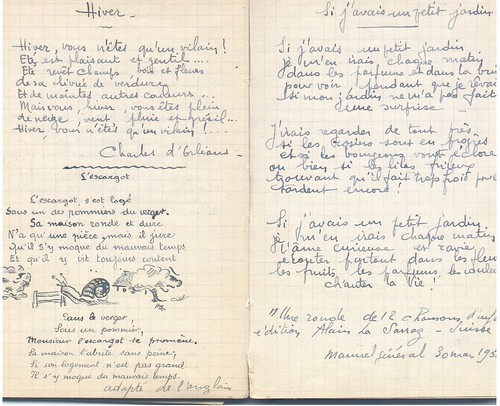
The Frenchie, like me, has been slowly but surely sifting through the effects of the past couple generations left to him when his parents passed away. Recently, he found a notebook belong to his mother where she'd jotted down favorite lyrics, poems, etc. Interesting to look back on these things and not have the same attachments as I have going through my own mother's things:
If you click on the image, it'll take you to the flickr site where you can find something larger and easier to read.
Hiver
Hiver, vous n'êtes qu'un villain
Eté est plaisant et gentil
Eté revêt champs, bois et fleurs
De sa Livrée de verdure
Et de maintes autres couleurs
Mais vous, Hiver, vous êtes plein
de neige, vent, pluie et grésil.
Hiver, vous n'êtes qu'un villain...
-Charles D'Orléans
(Apologies for the somewhat rough and on the fly translation:)
Winter
Oh, awful, awful Winter,
Summer is pleasant and sweet
Summer dresses up fields, woods and flowers
In verdant finery
touched with so many other colors
But you, Winter, you are filled
with snow, wind, rain and hail.
Oh, awful, awful Winter.
Also found in my wanders that Debussy set this to music.
The Frenchie, like me, has been slowly but surely sifting through the effects of the past couple generations left to him when his parents passed away. Recently, he found a notebook belong to his mother where she'd jotted down favorite lyrics, poems, etc. Interesting to look back on these things and not have the same attachments as I have going through my own mother's things:
If you click on the image, it'll take you to the flickr site where you can find something larger and easier to read.
Hiver
Hiver, vous n'êtes qu'un villain
Eté est plaisant et gentil
Eté revêt champs, bois et fleurs
De sa Livrée de verdure
Et de maintes autres couleurs
Mais vous, Hiver, vous êtes plein
de neige, vent, pluie et grésil.
Hiver, vous n'êtes qu'un villain...
-Charles D'Orléans
(Apologies for the somewhat rough and on the fly translation:)
Winter
Oh, awful, awful Winter,
Summer is pleasant and sweet
Summer dresses up fields, woods and flowers
In verdant finery
touched with so many other colors
But you, Winter, you are filled
with snow, wind, rain and hail.
Oh, awful, awful Winter.
Also found in my wanders that Debussy set this to music.
Tuesday, April 13, 2010
Then, There's Martial's Take On Things:
Issa est passere nequior Catulli,
Issa est purior osculo columbae,
Issa est blandior omnibus puellis,
Issa est carior Indicis lapillis,
Issa est deliciae catella Publi,
Hanc tu, si queritur, loqui putabis.
Sentit tristitiamque gaudiumque. . . .
et desiderio coacta ventris
gutta pallia non fefellit ulla,
sed blando pede suscitat toroque
deponi monet et rogat levari.
Castae tantus inest pudor catellae,
ignorat Venerem; nec invenimus
dignum tam tenerā virum puellā.
Hanc ne lux rapiat suprema totam,
pictā Publius exprimit tabellā,
in quā tam similem videbis Issam,
ut sit tam similis sibi nec ipsa.
Issam denique pone cum tabellā:
aut utramque putabis esse veram,
aut utramque putabis esse pictam.
***
Issa is naughtier than the sparrow of Catullus,
Issa is purer than the kiss of a dove,
Issa is more seductive than all the girls,
Issa is more precious than Indian diamonds,
Issa is the darling of Publius, his tiny puppy.
If she whines, you will think (that) this girl is speaking.
She feels sadness and joy.
and (when) compelled by the impulse of her bladder
not a single drop has befouled the covers,
but with her sweet paw she nudges (you) and from the couch
forewarns (you) that she needs to be put down and asks to be lifted up.
There is a very great sense of modesty in this virtuous little puppy,
she does not know Love; nor do we find
a mate worthy of a girl so delicate.
In order that (her) last day not snatch her altogether,
Publius portrays (her) in a painted picture,
in which you will see an Issa so similar
that she herself is not so similar to herself.
In short, place Issa alongside (her) picture:
either you will think that one is real,
Or you will think that the other is painted.
***
A couple interesting points here: The meter is hendecasyllablic (11 syllables on the line) - something a bit jarring at first, but easy to get the hang of reading aloud. Developed by the Greeks, its jaunty feel seems to be incongruous with the subject of Catullus's dead sparrow mourning. (I'd like to think that he was playing.) A generation later, Martial worked it in his somewhat biting but still affectionate elegy of Publius's heart's desire.
Also, there's a fair number of folks who believe that Issa was a Maltese, one of the oldest dog breeds in the world. Based on the images I've seen, could easily understand how someone could fall under the spell of such a little sweetie.

Image thanks to Dog and Collar dot com.
Issa est passere nequior Catulli,
Issa est purior osculo columbae,
Issa est blandior omnibus puellis,
Issa est carior Indicis lapillis,
Issa est deliciae catella Publi,
Hanc tu, si queritur, loqui putabis.
Sentit tristitiamque gaudiumque. . . .
et desiderio coacta ventris
gutta pallia non fefellit ulla,
sed blando pede suscitat toroque
deponi monet et rogat levari.
Castae tantus inest pudor catellae,
ignorat Venerem; nec invenimus
dignum tam tenerā virum puellā.
Hanc ne lux rapiat suprema totam,
pictā Publius exprimit tabellā,
in quā tam similem videbis Issam,
ut sit tam similis sibi nec ipsa.
Issam denique pone cum tabellā:
aut utramque putabis esse veram,
aut utramque putabis esse pictam.
***
Issa is naughtier than the sparrow of Catullus,
Issa is purer than the kiss of a dove,
Issa is more seductive than all the girls,
Issa is more precious than Indian diamonds,
Issa is the darling of Publius, his tiny puppy.
If she whines, you will think (that) this girl is speaking.
She feels sadness and joy.
and (when) compelled by the impulse of her bladder
not a single drop has befouled the covers,
but with her sweet paw she nudges (you) and from the couch
forewarns (you) that she needs to be put down and asks to be lifted up.
There is a very great sense of modesty in this virtuous little puppy,
she does not know Love; nor do we find
a mate worthy of a girl so delicate.
In order that (her) last day not snatch her altogether,
Publius portrays (her) in a painted picture,
in which you will see an Issa so similar
that she herself is not so similar to herself.
In short, place Issa alongside (her) picture:
either you will think that one is real,
Or you will think that the other is painted.
***
A couple interesting points here: The meter is hendecasyllablic (11 syllables on the line) - something a bit jarring at first, but easy to get the hang of reading aloud. Developed by the Greeks, its jaunty feel seems to be incongruous with the subject of Catullus's dead sparrow mourning. (I'd like to think that he was playing.) A generation later, Martial worked it in his somewhat biting but still affectionate elegy of Publius's heart's desire.
Also, there's a fair number of folks who believe that Issa was a Maltese, one of the oldest dog breeds in the world. Based on the images I've seen, could easily understand how someone could fall under the spell of such a little sweetie.

Image thanks to Dog and Collar dot com.
Monday, April 12, 2010
Sparrows have started pairing off in the yard; it's that time of the year. That and Sappho were what got me thinking about Catullus the other day. This, too:
Passer Mortuus Est
Death devours all lovely things;
Lesbia with her sparrow
Shares the darkness,--presently
Every bed is narrow.
Unremembered as old rain
Dries the sheer libation,
And the little petulant hand
Is an annotation.
After all, my erstwhile dear,
My no longer cherished,
Need we say it was not love,
Now that love is perished?
-Edna St. Vincent Millay
Passer Mortuus Est
Death devours all lovely things;
Lesbia with her sparrow
Shares the darkness,--presently
Every bed is narrow.
Unremembered as old rain
Dries the sheer libation,
And the little petulant hand
Is an annotation.
After all, my erstwhile dear,
My no longer cherished,
Need we say it was not love,
Now that love is perished?
-Edna St. Vincent Millay
Sunday, April 11, 2010
Sparrows.
A considerable chunk of what what remains today of Catullus's work refers to 'Lesbia,' his pseudonym for his lover Clodia, apparently a poet in her own right. These works, some of which are just fragmentary, run the gamut of emotions from ecstatic joy to despair and even cynicism. Probably the best known of these might be his musings on someone his love loved more than she loved him:
Sparrow, my lady's pet,
with whom she often plays whilst she holds you in her lap,
or gives you her finger-tip to peck and
provokes you to bite sharply,
whenever she, the bright-shining lady of my love,
has a mind for some sweet pretty play,
in hope, as I think, that when the sharper smart of love abates,
she may find some small relief from her pain—
ah, might I but play with you as she does,
and lighten the gloomy cares of my heart!
This is as welcome to me as (they say)
to the swift maiden was the golden apple,
which loosed her girdle too long tied.
Mourn, O Venuses and Cupids
and however many there are of charming people:
my girl's sparrow is dead—
the sparrow, delight of my girl,
whom that girl loved more than her own eyes.
For he was honey-sweet and had known
the lady better than a girl [knows] her mother herself,
nor did he move himself from that girl's lap,
but hopping around now here now there
he chirped constantly to his mistress alone,
he who now goes through the shadowy journey
thither, whence they deny that anyone returns.
But may it go badly for you evil shadows
of hell, who devour all beautiful things.
You have taken from me so beautiful a sparrow.
Oh evil deed! Oh wretched little sparrow!
Now through your deeds the eyes of my girl,
swollen with weeping, are red.

"Lesbia and Her Sparrow," Sir Edward John Poynter
A considerable chunk of what what remains today of Catullus's work refers to 'Lesbia,' his pseudonym for his lover Clodia, apparently a poet in her own right. These works, some of which are just fragmentary, run the gamut of emotions from ecstatic joy to despair and even cynicism. Probably the best known of these might be his musings on someone his love loved more than she loved him:
Sparrow, my lady's pet,
with whom she often plays whilst she holds you in her lap,
or gives you her finger-tip to peck and
provokes you to bite sharply,
whenever she, the bright-shining lady of my love,
has a mind for some sweet pretty play,
in hope, as I think, that when the sharper smart of love abates,
she may find some small relief from her pain—
ah, might I but play with you as she does,
and lighten the gloomy cares of my heart!
This is as welcome to me as (they say)
to the swift maiden was the golden apple,
which loosed her girdle too long tied.
Mourn, O Venuses and Cupids
and however many there are of charming people:
my girl's sparrow is dead—
the sparrow, delight of my girl,
whom that girl loved more than her own eyes.
For he was honey-sweet and had known
the lady better than a girl [knows] her mother herself,
nor did he move himself from that girl's lap,
but hopping around now here now there
he chirped constantly to his mistress alone,
he who now goes through the shadowy journey
thither, whence they deny that anyone returns.
But may it go badly for you evil shadows
of hell, who devour all beautiful things.
You have taken from me so beautiful a sparrow.
Oh evil deed! Oh wretched little sparrow!
Now through your deeds the eyes of my girl,
swollen with weeping, are red.

"Lesbia and Her Sparrow," Sir Edward John Poynter
Saturday, April 10, 2010
Something from Pavel:
A poem about fatherhood. It was in a high-school poetry reader of mine. The phrase "slimesilvered stone" stuck in my mind. Found the rest again. Remarkable plays of sound in the first stanza.
On the Beach at Fontana
Wind whines and whines the shingle,
The crazy pierstakes groan;
A senile sea numbers each single
Slimesilvered stone.
From whining wind and colder
Grey sea I wrap him warm
And touch his trembling fineboned shoulder
And boyish arm.
Around us fear, descending
Darkness of fear above
And in my heart how deep unending
Ache of love!
-James Joyce
A poem about fatherhood. It was in a high-school poetry reader of mine. The phrase "slimesilvered stone" stuck in my mind. Found the rest again. Remarkable plays of sound in the first stanza.
On the Beach at Fontana
Wind whines and whines the shingle,
The crazy pierstakes groan;
A senile sea numbers each single
Slimesilvered stone.
From whining wind and colder
Grey sea I wrap him warm
And touch his trembling fineboned shoulder
And boyish arm.
Around us fear, descending
Darkness of fear above
And in my heart how deep unending
Ache of love!
-James Joyce
Friday, April 09, 2010
Apologies for the skip. Have been battling both on the physical and mental fronts. The friend below's post got me to thinking a fair bit - both productively and not much so. Anyway, what I can offer is two chestnuts, as I have them always with me:
Griefs.
I measure every grief I meet
With analytic eyes;
I wonder if it weighs like mine,
Or has an easier size.
I wonder if they bore it long,
Or did it just begin?
I could not tell the date of mine,
It feels so old a pain.
I wonder if it hurts to live,
And if they have to try,
And whether, could they choose between,
They would not rather die.
I wonder if when years have piled--
Some thousands--on the cause
Of early hurt, if such a lapse
Could give them any pause;
Or would they go on aching still
Through centuries above,
Enlightened to a larger pain
By contrast with the love.
The grieved are many, I am told;
The reason deeper lies;--
Death is but one and comes but once,
And only nails the eyes.
There's grief of want, and grief of cold,--
A sort they call 'despair;'
There's banishment from native eyes,
In sight of native air.
And though I may not guess the kind
Correctly, yet to me
A piercing comfort it affords
In passing Calvary,
To note the fashions of the cross,
Of those that stand alone,
Still fascinated to presume
That some are like my own.
And the 'money' lines from this:
The world stands out on either side
No wider than the heart is wide;
Above the world is stretched the sky, --
No higher than the soul is high.
The heart can push the sea and land
Farther away on either hand;
The soul can split the sky in two,
And let the face of God shine through.
But East and West will pinch the heart
That can not keep them pushed apart;
And he whose soul is flat -- the sky
Will cave in on him by and by.
Am sorry to keep repeating these two works; see that I actually started the blog with them. Think that they might be a sort of leitmotif.
Griefs.
I measure every grief I meet
With analytic eyes;
I wonder if it weighs like mine,
Or has an easier size.
I wonder if they bore it long,
Or did it just begin?
I could not tell the date of mine,
It feels so old a pain.
I wonder if it hurts to live,
And if they have to try,
And whether, could they choose between,
They would not rather die.
I wonder if when years have piled--
Some thousands--on the cause
Of early hurt, if such a lapse
Could give them any pause;
Or would they go on aching still
Through centuries above,
Enlightened to a larger pain
By contrast with the love.
The grieved are many, I am told;
The reason deeper lies;--
Death is but one and comes but once,
And only nails the eyes.
There's grief of want, and grief of cold,--
A sort they call 'despair;'
There's banishment from native eyes,
In sight of native air.
And though I may not guess the kind
Correctly, yet to me
A piercing comfort it affords
In passing Calvary,
To note the fashions of the cross,
Of those that stand alone,
Still fascinated to presume
That some are like my own.
And the 'money' lines from this:
The world stands out on either side
No wider than the heart is wide;
Above the world is stretched the sky, --
No higher than the soul is high.
The heart can push the sea and land
Farther away on either hand;
The soul can split the sky in two,
And let the face of God shine through.
But East and West will pinch the heart
That can not keep them pushed apart;
And he whose soul is flat -- the sky
Will cave in on him by and by.
Am sorry to keep repeating these two works; see that I actually started the blog with them. Think that they might be a sort of leitmotif.
Wednesday, April 07, 2010
A friend who would like to remain anonymous sent this along. Found it in the newspaper the day they left an abusive relationship. Has kept a copy of it in their wallet ever since then.
After A While
After a while you learn
The subtle difference between
holding a hand and chaining a soul
and you learn that love doesn’t mean
leaning
and company doesn’t mean
security.
And you begin to learn
that kisses are contracts and
presents aren’t promises
and you begin to accept your defeats
with you head up and your eyes
ahead
with the grace of a woman
not the grief of a child
and you learn
to build all your roads on today
because tomorrow’s ground is
too uncertain for plans
and futures have a way
of falling down in mid-flight.
After a while you learn that sunshine burns if you get
too much
so you plant your own garden
and decorate your own soul
instead of waiting
for someone to bring you flowers.
And you learn that you really can endure
that you really are strong
and you really do have worth
and you learn and you learn
with every goodbye you learn.
-Veronica A. Shoffstall
After A While
After a while you learn
The subtle difference between
holding a hand and chaining a soul
and you learn that love doesn’t mean
leaning
and company doesn’t mean
security.
And you begin to learn
that kisses are contracts and
presents aren’t promises
and you begin to accept your defeats
with you head up and your eyes
ahead
with the grace of a woman
not the grief of a child
and you learn
to build all your roads on today
because tomorrow’s ground is
too uncertain for plans
and futures have a way
of falling down in mid-flight.
After a while you learn that sunshine burns if you get
too much
so you plant your own garden
and decorate your own soul
instead of waiting
for someone to bring you flowers.
And you learn that you really can endure
that you really are strong
and you really do have worth
and you learn and you learn
with every goodbye you learn.
-Veronica A. Shoffstall
Tuesday, April 06, 2010
It's both a bit comforting and disquieting to think on how little things change, despite time and space.
To Have Taken the Trouble
I’m broke and practically homeless.
This fatal city, Antioch,
has devoured all my money:
this fatal city with its extravagant life.
But I’m young and in excellent health.
Prodigious master of things Greek,
I know Aristotle and Plato through and through,
poets, orators, or anyone else you could mention.
I have some idea about military matters
and friends among the senior mercenaries.
I also have a foot in the administrative world;
I spent six months in Alexandria last year:
I know (and this is useful) something about what goes on there—
the scheming of Kakergetis, his dirty deals, and the rest of it.
So I consider myself completely qualified
to serve this country,
my beloved fatherland, Syria.
Whatever job they give me,
I’ll try to be useful to the country. That’s my intention.
But if they frustrate me with their maneuvers—
we know them, those smart operators: no need to say more here—
if they frustrate me, it’s not my fault.
I’ll approach Zabinas first,
and if that idiot doesn’t appreciate me,
I’ll go to his rival, Grypos.
And if that imbecile doesn’t take me on,
I’ll go straight to Hyrkanos.
One of the three will want me anyway.
And my conscience is quiet
about my not caring which one I chose:
the three of them are equally bad for Syria.
But, a ruined man, it’s not my fault.
I’m only trying, poor devil, to make ends meet.
The almighty gods ought to have taken the trouble
to create a fourth, an honest man.
I would gladly have gone along with him.
-C. P. Cavafy
To Have Taken the Trouble
I’m broke and practically homeless.
This fatal city, Antioch,
has devoured all my money:
this fatal city with its extravagant life.
But I’m young and in excellent health.
Prodigious master of things Greek,
I know Aristotle and Plato through and through,
poets, orators, or anyone else you could mention.
I have some idea about military matters
and friends among the senior mercenaries.
I also have a foot in the administrative world;
I spent six months in Alexandria last year:
I know (and this is useful) something about what goes on there—
the scheming of Kakergetis, his dirty deals, and the rest of it.
So I consider myself completely qualified
to serve this country,
my beloved fatherland, Syria.
Whatever job they give me,
I’ll try to be useful to the country. That’s my intention.
But if they frustrate me with their maneuvers—
we know them, those smart operators: no need to say more here—
if they frustrate me, it’s not my fault.
I’ll approach Zabinas first,
and if that idiot doesn’t appreciate me,
I’ll go to his rival, Grypos.
And if that imbecile doesn’t take me on,
I’ll go straight to Hyrkanos.
One of the three will want me anyway.
And my conscience is quiet
about my not caring which one I chose:
the three of them are equally bad for Syria.
But, a ruined man, it’s not my fault.
I’m only trying, poor devil, to make ends meet.
The almighty gods ought to have taken the trouble
to create a fourth, an honest man.
I would gladly have gone along with him.
-C. P. Cavafy
Monday, April 05, 2010
Ozymandias
I met a traveller from an antique land,
Who said -- "two vast and trunkless legs of stone
Stand in the desert ... near them, on the sand,
Half sunk a shattered visage lies, whose frown,
And wrinkled lips, and sneer of cold command,
Tell that its sculptor well those passions read
Which yet survive, stamped on these lifeless things,
The hand that mocked them, and the heart that fed;
And on the pedestal these words appear:
My name is Ozymandias, King of Kings,
Look on my Works ye Mighty, and despair!
Nothing beside remains. Round the decay
Of that colossal Wreck, boundless and bare
The lone and level sands stretch far away." -
-Percy Bysshe Shelley
I don't normally give a lot of thought to the what will be remembered of me when I'm gone, as I don't think I've had much of a life so far and I don't really know that I am legacy-worthy.
Lately have been working on cleaning up the legacies of three people from the two generations preceding mine and thinking an awful on the irony of their situations. Can't rightly say that any of the departed had intended for things to be as they turned out, much like Ozymandias/Ramses the Second couldn't have imagined the above outcome thousands of years after his death.
I met a traveller from an antique land,
Who said -- "two vast and trunkless legs of stone
Stand in the desert ... near them, on the sand,
Half sunk a shattered visage lies, whose frown,
And wrinkled lips, and sneer of cold command,
Tell that its sculptor well those passions read
Which yet survive, stamped on these lifeless things,
The hand that mocked them, and the heart that fed;
And on the pedestal these words appear:
My name is Ozymandias, King of Kings,
Look on my Works ye Mighty, and despair!
Nothing beside remains. Round the decay
Of that colossal Wreck, boundless and bare
The lone and level sands stretch far away." -
-Percy Bysshe Shelley
I don't normally give a lot of thought to the what will be remembered of me when I'm gone, as I don't think I've had much of a life so far and I don't really know that I am legacy-worthy.
Lately have been working on cleaning up the legacies of three people from the two generations preceding mine and thinking an awful on the irony of their situations. Can't rightly say that any of the departed had intended for things to be as they turned out, much like Ozymandias/Ramses the Second couldn't have imagined the above outcome thousands of years after his death.
Sunday, April 04, 2010
Happy Easter!
(From one of my favorite Easter works.)
(When I chase down one of my Messiah scores, will get the words from this duet down; the sound quality and diction are both excellent, so not much of a problem understanding. Love the Tenor's "dancing on the forehead of God" metaphor. Back when I used to sing, loved a lot of the folks who got threatened with excommunication under the Council of Trent; saw them as communing with Angels.)
(From one of my favorite Easter works.)
(When I chase down one of my Messiah scores, will get the words from this duet down; the sound quality and diction are both excellent, so not much of a problem understanding. Love the Tenor's "dancing on the forehead of God" metaphor. Back when I used to sing, loved a lot of the folks who got threatened with excommunication under the Council of Trent; saw them as communing with Angels.)
Apologies for no post for yesterday: we were out enjoying the beautiful, summery day with an adventure of sorts for Pavel's Birthday. Normally when we take walks, we head north or west; lots of water and trees there, therefore lots of birds to look at. Yesterday, though, Pavel wanted to visit one of the sites near us on the Freedom Trail. So, we wandered on over to Charlestown to the Bunker Hill Monument.
He thought it would be fun to climb to the top; I don't do heights, crowds or enclosed spaces, so decided to park myself on a bench and knock off a few rows on a current project.
Felt like a happy turtle basking in the sun. Also enjoyed the waves of different languages washing over me. A large family of Spanish speakers was sitting on the steps of the monument in the shade enjoying a picnic lunch. Listened to the strange French of a number of Canadian teenagers next to the Latin family who were draping themselves against the columns and mugging for the camera. From behind me, caught the beautiful English (and this is, honestly, the flower of our Language) of an Indian couple playing on the lawn with a whole bunch of toddlers while the rest of the extended family climbed stairs.
Glanced up periodically from my work to look at the handsome as anything middle aged man on the bench next to mine as he compared the English Language site map with a Japanese one. While I was admiring the fellow next to me's cheekbones and crow-colored hair shot through with silver, the three Australian ladies who were sharing a bench with me left. Taking their place was a young fellow in baggy jeans and flip flops who looked surprisingly like me. Made no effort to hide his interest in my handwork or the pattern I referred to from time to time next to him. Glancing up as inobtrusively as possible, I tried to figure out where he was from. Eventually, his friend, a really pretty Latin-looking girl, sat down between us and they started chatting in something that was decidedly not Indo European. Took the brain a bit of channel surfing to figure out that it was Hebrew of all things.
Anyway, here I was resting in the center of what I honestly consider a new Athens marveling at the pilgrims to one of the monuments to honest, representative Democracy. Felt the words of (yeah, I'm going to call him that) an American Herodotus well up:
Happy Birthday, Pavel, and Salut au Monde!
He thought it would be fun to climb to the top; I don't do heights, crowds or enclosed spaces, so decided to park myself on a bench and knock off a few rows on a current project.
Felt like a happy turtle basking in the sun. Also enjoyed the waves of different languages washing over me. A large family of Spanish speakers was sitting on the steps of the monument in the shade enjoying a picnic lunch. Listened to the strange French of a number of Canadian teenagers next to the Latin family who were draping themselves against the columns and mugging for the camera. From behind me, caught the beautiful English (and this is, honestly, the flower of our Language) of an Indian couple playing on the lawn with a whole bunch of toddlers while the rest of the extended family climbed stairs.
Glanced up periodically from my work to look at the handsome as anything middle aged man on the bench next to mine as he compared the English Language site map with a Japanese one. While I was admiring the fellow next to me's cheekbones and crow-colored hair shot through with silver, the three Australian ladies who were sharing a bench with me left. Taking their place was a young fellow in baggy jeans and flip flops who looked surprisingly like me. Made no effort to hide his interest in my handwork or the pattern I referred to from time to time next to him. Glancing up as inobtrusively as possible, I tried to figure out where he was from. Eventually, his friend, a really pretty Latin-looking girl, sat down between us and they started chatting in something that was decidedly not Indo European. Took the brain a bit of channel surfing to figure out that it was Hebrew of all things.
Anyway, here I was resting in the center of what I honestly consider a new Athens marveling at the pilgrims to one of the monuments to honest, representative Democracy. Felt the words of (yeah, I'm going to call him that) an American Herodotus well up:
13
My spirit has pass'd in compassion and determination around the whole earth,
I have look'd for equals and lovers and found them ready for me in
all lands,
I think some divine rapport has equalized me with them.
You vapors, I think I have risen with you, moved away to distant
continents, and fallen down there, for reasons,
I think I have blown with you you winds;
You waters I have finger'd every shore with you,
I have run through what any river or strait of the globe has run through,
I have taken my stand on the bases of peninsulas and on the high
embedded rocks, to cry thence:
What cities the light or warmth penetrates I penetrate those cities myself,
All islands to which birds wing their way I wing my way myself.
Toward you all, in America's name,
I raise high the perpendicular hand, I make the signal,
To remain after me in sight forever,
For all the haunts and homes of men.
Happy Birthday, Pavel, and Salut au Monde!
Friday, April 02, 2010
What to Make of Modern/Feminist Interpretations of Sappho?
Recent readings in History have caused me to wonder more about the point of view of the historians, semioticians, linguists, etc than of the times I'd been interested in. The remains of Sappho's body of work and how it had been interpreted by the whole Gertrude Stein crew at the turn of the 20th century kind of brought it into sharp focus, as these translations are viewed somewhat as "bible."
Still, these bits are really tempting, just like the crusts of a sandwich offered to a pigeon or duck in a park:
Just tesserae, fragments of what we have left of her poetry. Makes me think of a young one feeling love for the first time. Beautiful, Fresh, Spring-like. A Romantic Ideal, but perhaps not so sustainable in Real Life. How much of it is hers, and how much of it is wishful thinking on the part of the interpreters?
***
1. Sources of The Making of the West, V. 1; Katherine J. Lualdi. Bedford/St. Martins, Boston. Pp. 15-19.
2. Ibid.
3. Ibid.
Recent readings in History have caused me to wonder more about the point of view of the historians, semioticians, linguists, etc than of the times I'd been interested in. The remains of Sappho's body of work and how it had been interpreted by the whole Gertrude Stein crew at the turn of the 20th century kind of brought it into sharp focus, as these translations are viewed somewhat as "bible."
Still, these bits are really tempting, just like the crusts of a sandwich offered to a pigeon or duck in a park:
To Aphrodite (Fr. 1. G) 1
Aphrodite on your intricate throne, immortal, daughter of Zeus, weaver of plots, I beg you, do not tame me with pain or my heart with anguish
but come here, as once before when I asked you, you heard my words from afar and listened, and left your father's golden house and came
you yoked your chariot, and lovely swift sparrows brought you, fast whirling over the dark earth from heaven through the midst of the bright air
and soon they arrived. And you, o blessed goddess, smiled with your immortal face and asked what was wrong with me, and why did I call now,
and what did I most want in my maddened heart to have for myself. "Whom now am I to persuade to your love, who, Sappho, has done you wrong? For if she flees, soon she'll pursue you, and if she won't take gifts, soon she'll give them, and if she won't love, soon she will love you, even if she doesn't want to.
When I Look at You (Fr. 31. G) 2
The man seems to me strong as a god, the man who sits across from you and listens to your sweet talk nearby
and your lovely laughter - which, when I hear it, strikes fear in the heart of my breast. For whenever I glance at you, it seems that I can say nothing at all
but my tongue is broken in silence, and that instant a light fire rushes beneath my skin, I can no longer see anything in my eyes and my ears are thundering,
and cold sweat pours down me, and shuddering grasps me all over, and I am greener than grass, and I seem to myself to be little short of death
But it is endurable, since even a poor man...
Anactoria (Fr. 16. G) 3
Some would say an army of cavalry, others of infantry, others of ships, is the fairest thing on the dark earth, but I say it's whatever you're in love with
It's completely easy to make this clear to everyone, for Helen, who far surpassed other people in beauty, left behind the most aristocratic
of husbands and went to Troy. She sailed away, and did not remember at all her daughter or her beloved parents, but [Aphrodite] took her aside
(...) which makes me remember Anactoria who is no longer near,
her lovely step and the brilliant glancing of her face I would rather see than the Lydians' chariots or their infantry fighting in all their armo(u)r.
Just tesserae, fragments of what we have left of her poetry. Makes me think of a young one feeling love for the first time. Beautiful, Fresh, Spring-like. A Romantic Ideal, but perhaps not so sustainable in Real Life. How much of it is hers, and how much of it is wishful thinking on the part of the interpreters?
***
1. Sources of The Making of the West, V. 1; Katherine J. Lualdi. Bedford/St. Martins, Boston. Pp. 15-19.
2. Ibid.
3. Ibid.
Thursday, April 01, 2010
According to Amy Kelly in her Eleanor and the Four Kings, what remained of the Western Empire at the time wasn't much of a place for a young woman, either:
Had a part of her been left behind in this Holy Land after the fateful crusade of her Pious First Husband? Was there a fusion between her inherited ambitious nature and the subtler, more refined manners of the Imperial Court (which moved "with the supernal majesty and order of the heavenly constellations" 3) that would later provide the inspiration for her seditious "Tribunals of Love?"
Am wondering, too, if the country of origin is "no country for old men," perhaps Byzantium with all its beyond the wildest dreams of even a princess glories could be "no place for a young woman" for all the disappointment it would later set up for.
Sailing To Byzantium
I
That is no country for old men. The young
In one another’s arms, birds in the trees
—Those dying generations—at their song,
The salmon-falls, the mackerel-crowded seas,
Fish, flesh, or fowl, commend all summer long
Whatever is begotten, born, and dies.
Caught in that sensual music all neglect
Monuments of unageing intellect.
II
An aged man is but a paltry thing,
A tattered coat upon a stick, unless
Soul clap its hands and sing, and louder sing
For every tatter in its mortal dress,
Nor is there singing school but studying
Monuments of its own magnificence;
And therefore I have sailed the seas and come
To the holy city of Byzantium.
III
O sages standing in God’s holy fire
As in the gold mosaic of a wall,
Come from the holy fire, perne in a gyre,
And be the singing-masters of my soul.
Consume my heart away; sick with desire
And fastened to a dying animal
It knows not what it is; and gather me
Into the artifice of eternity.
IV
Once out of nature I shall never take
My bodily form from any natural thing,
But such a form as Grecian goldsmiths make
Of hammered gold and gold enamelling
To keep a drowsy Emperor awake;
Or set upon a golden bough to sing
To lords and ladies of Byzantium
Of what is past, or passing, or to come.
-William Butler Yeats
***
1. Melancholy, sadness, immobility.
2. Kelly, pp.42-43
3. Kelly, pg. 43.
"If the sojourn among the shrines of Byzantium was a nine days' wonder to the king, it was an awakening experience for the queen, whose education had progressed just far enough to make her travels profitable. It opened her eyes to vast, lofty, undreamed-of possibilities for majesty, and all the accidia 1 from which she had suffered at home was purged from her soul. The magnificent entertainment of the crusaders in Manuel's capital was of a nature to fire the imagination of the young Queen of France. The reality was far above the rumor, and every way extravagant. She learned that Paris was not, as she had been taught by her clerks, the highest of all places in Christendom. Byzantium, set in its pomp of water and of light, was not only incredibly vaster; it was infinitely more refined. The famous city had inherited much of the outward grandeur of ancient Rome, but was as well a treasury of artistic marvels that had drifted down to the Bosporus from Persia and Cathay, from Baghdad and Mosul..." 2
Had a part of her been left behind in this Holy Land after the fateful crusade of her Pious First Husband? Was there a fusion between her inherited ambitious nature and the subtler, more refined manners of the Imperial Court (which moved "with the supernal majesty and order of the heavenly constellations" 3) that would later provide the inspiration for her seditious "Tribunals of Love?"
Am wondering, too, if the country of origin is "no country for old men," perhaps Byzantium with all its beyond the wildest dreams of even a princess glories could be "no place for a young woman" for all the disappointment it would later set up for.
Sailing To Byzantium
I
That is no country for old men. The young
In one another’s arms, birds in the trees
—Those dying generations—at their song,
The salmon-falls, the mackerel-crowded seas,
Fish, flesh, or fowl, commend all summer long
Whatever is begotten, born, and dies.
Caught in that sensual music all neglect
Monuments of unageing intellect.
II
An aged man is but a paltry thing,
A tattered coat upon a stick, unless
Soul clap its hands and sing, and louder sing
For every tatter in its mortal dress,
Nor is there singing school but studying
Monuments of its own magnificence;
And therefore I have sailed the seas and come
To the holy city of Byzantium.
III
O sages standing in God’s holy fire
As in the gold mosaic of a wall,
Come from the holy fire, perne in a gyre,
And be the singing-masters of my soul.
Consume my heart away; sick with desire
And fastened to a dying animal
It knows not what it is; and gather me
Into the artifice of eternity.
IV
Once out of nature I shall never take
My bodily form from any natural thing,
But such a form as Grecian goldsmiths make
Of hammered gold and gold enamelling
To keep a drowsy Emperor awake;
Or set upon a golden bough to sing
To lords and ladies of Byzantium
Of what is past, or passing, or to come.
-William Butler Yeats
***
1. Melancholy, sadness, immobility.
2. Kelly, pp.42-43
3. Kelly, pg. 43.
Wow, another year gone by and another Poetry Month to celebrate.
Have been doing this for quite a long time now, so hopefully the drill's apparent: Although I'm just posting what moves me at the time, I do take requests and would love to hear about what moves you. If there is a poem that is particularly near and dear to your heart, why not talk about it? Send me a link to your website if you post your thoughts there, or just email me your submission and I'll post it on my site. (I'll keep things anonymous, too, if that is an incitement to write.)
Happy April Fool's Day, Happy April Fish, Happy (Hopeful) Spring!
Have been doing this for quite a long time now, so hopefully the drill's apparent: Although I'm just posting what moves me at the time, I do take requests and would love to hear about what moves you. If there is a poem that is particularly near and dear to your heart, why not talk about it? Send me a link to your website if you post your thoughts there, or just email me your submission and I'll post it on my site. (I'll keep things anonymous, too, if that is an incitement to write.)
Happy April Fool's Day, Happy April Fish, Happy (Hopeful) Spring!
Thursday, April 30, 2009
My, how the month flew by. Figured that I'd close up shop for another year with a favorite Shakespeare Monologue:
"All the world's a stage,
And all the men and women merely players;
They have their exits and their entrances;
And one man in his time plays many parts,
His acts being seven ages. At first the infant,
Mewling and puking in the nurse's arms;
And then the whining school-boy, with his satchel
And shining morning face, creeping like snail
Unwillingly to school. And then the lover,
Sighing like furnace, with a woeful ballad
Made to his mistress' eyebrow. Then a soldier,
Full of strange oaths, and bearded like the pard,
Jealous in honour, sudden and quick in quarrel,
Seeking the bubble reputation
Even in the cannon's mouth. And then the justice,
In fair round belly with good capon lin'd,
With eyes severe and beard of formal cut,
Full of wise saws and modern instances;
And so he plays his part. The sixth age shifts
Into the lean and slipper'd pantaloon,
With spectacles on nose and pouch on side;
His youthful hose, well sav'd, a world too wide
For his shrunk shank; and his big manly voice,
Turning again toward childish treble, pipes
And whistles in his sound. Last scene of all,
That ends this strange eventful history,
Is second childishness and mere oblivion;
Sans teeth, sans eyes, sans taste, sans everything." — Jaques (As You Like It, Act II, Scene VII, lines 139-166)
***
Until next year!
"All the world's a stage,
And all the men and women merely players;
They have their exits and their entrances;
And one man in his time plays many parts,
His acts being seven ages. At first the infant,
Mewling and puking in the nurse's arms;
And then the whining school-boy, with his satchel
And shining morning face, creeping like snail
Unwillingly to school. And then the lover,
Sighing like furnace, with a woeful ballad
Made to his mistress' eyebrow. Then a soldier,
Full of strange oaths, and bearded like the pard,
Jealous in honour, sudden and quick in quarrel,
Seeking the bubble reputation
Even in the cannon's mouth. And then the justice,
In fair round belly with good capon lin'd,
With eyes severe and beard of formal cut,
Full of wise saws and modern instances;
And so he plays his part. The sixth age shifts
Into the lean and slipper'd pantaloon,
With spectacles on nose and pouch on side;
His youthful hose, well sav'd, a world too wide
For his shrunk shank; and his big manly voice,
Turning again toward childish treble, pipes
And whistles in his sound. Last scene of all,
That ends this strange eventful history,
Is second childishness and mere oblivion;
Sans teeth, sans eyes, sans taste, sans everything." — Jaques (As You Like It, Act II, Scene VII, lines 139-166)
***
Until next year!
Wednesday, April 29, 2009
There have been many almost unbearably beautiful days this Spring. Have been reveling in the gorgeousness.
God's World
O world, I cannot hold thee close enough!
Thy winds, thy wide grey skies!
Thy mists that roll and rise!
Thy woods, this autumn day, that ache and sag
And all but cry with colour! That gaunt crag
To crush! To lift the lean of that black bluff!
World, World, I cannot get thee close enough!
Long have I known a glory in it all,
But never knew I this;
Here such a passion is
As stretcheth me apart. Lord, I do fear
Thou'st made the world too beautiful this year.
My soul is all but out of me, let fall
No burning leaf; prithee, let no bird call.
-Edna St. Vincent Millay
God's World
O world, I cannot hold thee close enough!
Thy winds, thy wide grey skies!
Thy mists that roll and rise!
Thy woods, this autumn day, that ache and sag
And all but cry with colour! That gaunt crag
To crush! To lift the lean of that black bluff!
World, World, I cannot get thee close enough!
Long have I known a glory in it all,
But never knew I this;
Here such a passion is
As stretcheth me apart. Lord, I do fear
Thou'st made the world too beautiful this year.
My soul is all but out of me, let fall
No burning leaf; prithee, let no bird call.
-Edna St. Vincent Millay
Tuesday, April 28, 2009
Breakfast.
(this morning
i had a banana,
two apples,
and a spoonful of
damson plum jam;
was a good start for a hot day.)
This Is Just To Say
I have eaten
the plums
that were in
the icebox
and which
you were probably
saving
for breakfast
Forgive me
they were delicious
so sweet
and so cold
- William Carlos Williams
(this morning
i had a banana,
two apples,
and a spoonful of
damson plum jam;
was a good start for a hot day.)
This Is Just To Say
I have eaten
the plums
that were in
the icebox
and which
you were probably
saving
for breakfast
Forgive me
they were delicious
so sweet
and so cold
- William Carlos Williams
Monday, April 27, 2009

Sunday, April 26, 2009
"For of all sad words of tongue or pen, the saddest are these: “It might have been!”
A sad one from my dad.
Maud Muller
Maud Muller, on a summer’s day,
Raked the meadow sweet with hay.
Beneath her torn hat glowed the wealth
Of simple beauty and rustic health.
Singing, she wrought, and her merry glee
The mock-bird echoed from his tree.
But when she glanced to the far-off town,
White from its hill-slope looking down,
The sweet song died, and a vague unrest
And a nameless longing filled her breast,
A wish, that she hardly dared to own,
For something better than she had known.
The Judge rode slowly down the lane,
Smoothing his horse’s chestnut mane.
He drew his bridle in the shade
Of the apple-trees, to greet the maid,
And ask a draught from the spring that flowed
Through the meadow across the road.
She stooped where the cool spring bubbled up,
And filled for him her small tin cup,
And blushed as she gave it, looking down
On her feet so bare, and her tattered gown.
“Thanks!” said the Judge; “a sweeter draught
From a fairer hand was never quaffed.”
He spoke of the grass and flowers and trees,
Of the singing birds and the humming bees;
Then talked of the haying, and wondered whether
The cloud in the west would bring foul weather.
And Maud forgot her brier-torn gown,
And her graceful ankles bare and brown;
And listened, while a pleased surprise
Looked from her long-lashed hazel eyes.
At last, like one who for delay
Seeks a vain excuse, he rode away.
Maud Muller looked and sighed: “Ah me!
That I the Judge’s bride might be!
“He would dress me up in silks so fine,
And praise and toast me at his wine.
“My father should wear a broadcloth coat;
My brother should sail a painted boat.
“I’d dress my mother so grand and gay,
And the baby should have a new toy each day.
“And I’d feed the hungry and clothe the poor
And all should bless me who left our door.”
The Judge looked back as he climbed the hill,
And saw Maud Muller standing still.
“A form more fair, a face more sweet
Ne’er hath it been my lot to meet.
“And her modest answer and graceful air
Show her wise and good as she is fair.
“Would she were mine, and I to-day,
Like her, a harvester of hay
“No doubtful balance of rights and wrongs,
Nor weary lawyers with endless tongues,
“But low of cattle and song of birds,
And health and quiet and loving words.”
But he thought of his sisters proud and cold,
And his mother vain of her rank and gold.
So, closing his heart, the judge rode on,
And Maud was left in the field alone.
But the lawyers smiled that afternoon,
When he hummed in court an old love-tune;
And the young girl mused beside the well,
Till the rain on the unraked clover fell,
He wedded a wife of richest dower,
Who lived for fashion, as he for power.
Yet oft, in his marble hearth’s bright glow,
He watched a picture come and go;
And sweet Maud Muller’s hazel eyes
Looked out in their innocent surprise.
Oft, when the wine in his glass was red,
He longed for the wayside well instead;
And closed his eyes on his garnished rooms
To dream of meadows and clover-blooms.
And the proud man sighed, with a secret pain,
“Ah, that I were free again!
“Free as when I rode that day,
Where the barefoot maiden raked her hay.”
She wedded a man unlearned and poor,
And many children played round her door.
But care and sorrow, and childbirth pain,
Left their traces on heart and brain.
And oft, when the summer sun shone hot
On the new-mown hay in the meadow lot,
And she heard the little spring brook fall
Over the roadside, through the wall;
In the shade of the apple-tree again
She saw a rider draw his rein.
And gazing down with timid grace
She felt his pleased eyes read her face.
Sometimes her narrow kitchen walls
Stretched away into stately halls;
The weary wheel to a spinnet turned,
The tallow candle an astral burned,
And for him who sat by the chimney lug,
Dozing and grumbling o'er pipe and mug,
A manly form at her side she saw,
And joy was duty and love was law.
Then she took up her burden of life again,
Saying only, “it might have been.”
Alas for maiden, alas for Judge,
For rich repiner and household drudge!
God pity them both! and pity us all,
Who vainly the dreams of youth recall.
For of all sad words of tongue or pen,
The saddest are these: “It might have been!”
Ah, well! for us all some sweet hope lies
Deeply buried from human eyes;
And, in the hereafter, angels may
Roll the stone from its grave away!
-John Greenleaf Whittier
A sad one from my dad.
Maud Muller
Maud Muller, on a summer’s day,
Raked the meadow sweet with hay.
Beneath her torn hat glowed the wealth
Of simple beauty and rustic health.
Singing, she wrought, and her merry glee
The mock-bird echoed from his tree.
But when she glanced to the far-off town,
White from its hill-slope looking down,
The sweet song died, and a vague unrest
And a nameless longing filled her breast,
A wish, that she hardly dared to own,
For something better than she had known.
The Judge rode slowly down the lane,
Smoothing his horse’s chestnut mane.
He drew his bridle in the shade
Of the apple-trees, to greet the maid,
And ask a draught from the spring that flowed
Through the meadow across the road.
She stooped where the cool spring bubbled up,
And filled for him her small tin cup,
And blushed as she gave it, looking down
On her feet so bare, and her tattered gown.
“Thanks!” said the Judge; “a sweeter draught
From a fairer hand was never quaffed.”
He spoke of the grass and flowers and trees,
Of the singing birds and the humming bees;
Then talked of the haying, and wondered whether
The cloud in the west would bring foul weather.
And Maud forgot her brier-torn gown,
And her graceful ankles bare and brown;
And listened, while a pleased surprise
Looked from her long-lashed hazel eyes.
At last, like one who for delay
Seeks a vain excuse, he rode away.
Maud Muller looked and sighed: “Ah me!
That I the Judge’s bride might be!
“He would dress me up in silks so fine,
And praise and toast me at his wine.
“My father should wear a broadcloth coat;
My brother should sail a painted boat.
“I’d dress my mother so grand and gay,
And the baby should have a new toy each day.
“And I’d feed the hungry and clothe the poor
And all should bless me who left our door.”
The Judge looked back as he climbed the hill,
And saw Maud Muller standing still.
“A form more fair, a face more sweet
Ne’er hath it been my lot to meet.
“And her modest answer and graceful air
Show her wise and good as she is fair.
“Would she were mine, and I to-day,
Like her, a harvester of hay
“No doubtful balance of rights and wrongs,
Nor weary lawyers with endless tongues,
“But low of cattle and song of birds,
And health and quiet and loving words.”
But he thought of his sisters proud and cold,
And his mother vain of her rank and gold.
So, closing his heart, the judge rode on,
And Maud was left in the field alone.
But the lawyers smiled that afternoon,
When he hummed in court an old love-tune;
And the young girl mused beside the well,
Till the rain on the unraked clover fell,
He wedded a wife of richest dower,
Who lived for fashion, as he for power.
Yet oft, in his marble hearth’s bright glow,
He watched a picture come and go;
And sweet Maud Muller’s hazel eyes
Looked out in their innocent surprise.
Oft, when the wine in his glass was red,
He longed for the wayside well instead;
And closed his eyes on his garnished rooms
To dream of meadows and clover-blooms.
And the proud man sighed, with a secret pain,
“Ah, that I were free again!
“Free as when I rode that day,
Where the barefoot maiden raked her hay.”
She wedded a man unlearned and poor,
And many children played round her door.
But care and sorrow, and childbirth pain,
Left their traces on heart and brain.
And oft, when the summer sun shone hot
On the new-mown hay in the meadow lot,
And she heard the little spring brook fall
Over the roadside, through the wall;
In the shade of the apple-tree again
She saw a rider draw his rein.
And gazing down with timid grace
She felt his pleased eyes read her face.
Sometimes her narrow kitchen walls
Stretched away into stately halls;
The weary wheel to a spinnet turned,
The tallow candle an astral burned,
And for him who sat by the chimney lug,
Dozing and grumbling o'er pipe and mug,
A manly form at her side she saw,
And joy was duty and love was law.
Then she took up her burden of life again,
Saying only, “it might have been.”
Alas for maiden, alas for Judge,
For rich repiner and household drudge!
God pity them both! and pity us all,
Who vainly the dreams of youth recall.
For of all sad words of tongue or pen,
The saddest are these: “It might have been!”
Ah, well! for us all some sweet hope lies
Deeply buried from human eyes;
And, in the hereafter, angels may
Roll the stone from its grave away!
-John Greenleaf Whittier
Saturday, April 25, 2009
Sure does feel like Summertime right now. (whew)
Summertime
Summertime,
And the livin' is easy
Fish are jumpin'
And the cotton is high
Your daddy's rich
And your mamma's good lookin'
So hush little baby
Don't you cry
One of these mornings
You're going to rise up singing
Then you'll spread your wings
And you'll take to the sky
But till that morning
There's a'nothing can harm you
-George Gershwin
Gosh, I love Mike Brant's version. (sigh)
Summertime
Summertime,
And the livin' is easy
Fish are jumpin'
And the cotton is high
Your daddy's rich
And your mamma's good lookin'
So hush little baby
Don't you cry
One of these mornings
You're going to rise up singing
Then you'll spread your wings
And you'll take to the sky
But till that morning
There's a'nothing can harm you
-George Gershwin
Gosh, I love Mike Brant's version. (sigh)
Friday, April 24, 2009
The ocean is such a short ride, heck, even walk away, and yet I never seem to have the time or energy to visit. This is ironic, given how much better I feel after having spent time in it or beside it.
maggie and milly and molly and may
maggie and milly and molly and may
went down to the beach(to play one day)
and maggie discovered a shell that sang
so sweetly she couldn't remember her troubles,and
milly befriended a stranded star
whose rays five languid fingers were;
and molly was chased by a horrible thing
which raced sideways while blowing bubbles:and
may came home with a smooth round stone
as small as a world and as large as alone.
For whatever we lose(like a you or a me)
it's always ourselves we find in the sea
- e. e. cummings
maggie and milly and molly and may
maggie and milly and molly and may
went down to the beach(to play one day)
and maggie discovered a shell that sang
so sweetly she couldn't remember her troubles,and
milly befriended a stranded star
whose rays five languid fingers were;
and molly was chased by a horrible thing
which raced sideways while blowing bubbles:and
may came home with a smooth round stone
as small as a world and as large as alone.
For whatever we lose(like a you or a me)
it's always ourselves we find in the sea
- e. e. cummings
Thursday, April 23, 2009
Water
Everything on the earth bristled, the bramble
pricked and the green thread
nibbled away, the petal fell, falling
until the only flower was the falling itself.
Water is another matter,
has no direction but its own bright grace,
runs through all imaginable colors,
takes limpid lessons
from stone,
and in those functionings plays out
the unrealized ambitions of the foam.
-Pablo Neruda
There's been plenty of water from the sky the past few days. The sun is out now, though, so we're going in search of some other water. Will be back in a day or two.
Everything on the earth bristled, the bramble
pricked and the green thread
nibbled away, the petal fell, falling
until the only flower was the falling itself.
Water is another matter,
has no direction but its own bright grace,
runs through all imaginable colors,
takes limpid lessons
from stone,
and in those functionings plays out
the unrealized ambitions of the foam.
-Pablo Neruda
There's been plenty of water from the sky the past few days. The sun is out now, though, so we're going in search of some other water. Will be back in a day or two.
Wednesday, April 22, 2009
Lots of rain the past couple days. That's okay; we kind of need it. This year's April has been kind of a dry one.
As I sit up here in my little garret, can hear the drops pattering on the skylight windows. It's a very comforting sound, this. Reminds me that I'm safe and secure; brings me back to a time when I was little and everything was okay. It will be easy to sleep tonight wrapped in such comforting feelings and surrounded by such soothing sounds.
Rain
As the falling rain
trickles among the stones
memories come bubbling out.
It's as if the rain
had pierced my temples.
Streaming
streaming chaotically
come memories:
the reedy voice
of the servant
telling me tales
of ghosts.
They sat beside me
the ghosts
and the bed creaked
that purple-dark afternoon
when I learned you were leaving forever,
a gleaming pebble
from constant rubbing
becomes a comet.
Rain is falling
falling
and memories keep flooding by
they show me a senseless
world
a voracious
world--abyss
ambush
whirlwind
spur
but I keep loving it
because I do
because of my five senses
because of my amazement
because every morning,
because forever, I have loved it
without knowing why.
- Claribel Alegría
Translated by Margaret S. Peden
As I sit up here in my little garret, can hear the drops pattering on the skylight windows. It's a very comforting sound, this. Reminds me that I'm safe and secure; brings me back to a time when I was little and everything was okay. It will be easy to sleep tonight wrapped in such comforting feelings and surrounded by such soothing sounds.
Rain
As the falling rain
trickles among the stones
memories come bubbling out.
It's as if the rain
had pierced my temples.
Streaming
streaming chaotically
come memories:
the reedy voice
of the servant
telling me tales
of ghosts.
They sat beside me
the ghosts
and the bed creaked
that purple-dark afternoon
when I learned you were leaving forever,
a gleaming pebble
from constant rubbing
becomes a comet.
Rain is falling
falling
and memories keep flooding by
they show me a senseless
world
a voracious
world--abyss
ambush
whirlwind
spur
but I keep loving it
because I do
because of my five senses
because of my amazement
because every morning,
because forever, I have loved it
without knowing why.
- Claribel Alegría
Translated by Margaret S. Peden
Tuesday, April 21, 2009
The forsythia, primroses, pansies and crocuses will soon give way to cherries, azaleas, daffodils and lilacs, which will then fade into the background for the dogwoods, roses, wisteria and peonies. So goes this natural progression of blossoming, going to seed, then lying dormant until the next Spring.
Nothing Gold Can Stay
Nature's first green is gold,
Her hardest hue to hold.
Her early leafs a flower;
But only so an hour.
Then leaf subsides to leaf.
So Eden sank to grief,
So dawn goes down to day.
Nothing gold can stay.
-Robert Frost
Nothing Gold Can Stay
Nature's first green is gold,
Her hardest hue to hold.
Her early leafs a flower;
But only so an hour.
Then leaf subsides to leaf.
So Eden sank to grief,
So dawn goes down to day.
Nothing gold can stay.
-Robert Frost
Monday, April 20, 2009
It's Patriots Day. You know the drill.
Paul Revere's Ride
LISTEN, my children, and you shall hear
Of the midnight ride of Paul Revere,
On the eighteenth of April, in Seventy-Five;
Hardly a man is now alive
Who remembers that famous day and year.
He said to his friend, "If the British march
By land or sea from the town to-night,
Hang a lantern aloft in the belfry arch
Of the North Church tower, as a signal light, --
One, if by land, and two, if by sea;
And I on the opposite shore will be,
Ready to ride and spread the alarm
Through every Middlesex village and farm,
For the country-folk to be up and to arm."
Then he said "Good-night!" and with muffled oar
Silently rowed to the Charlestown shore,
Just as the moon rose over the bay,
Where swinging wide at her moorings lay
The Somerset, British man-of-war;
A phantom ship, with each mast and spar
Across the moon like a prison-bar,
And a huge black hulk, that was magnified
By its own reflection in the tide.
Meanwhile, his friend, through alley and street
Wanders and watches with eager ears,
Till in the silence around him he hears
The muster of men at the barrack door,
The sound of arms, and the tramp of feet,
And the measured tread of the grenadiers,
Marching down to their boats on the shore.
Then he climbed the tower of the Old North Church,
By the wooden stairs, with stealthy tread,
To the belfry-chamber overhead,
And startled the pigeons from their perch
On the somber rafters, that round him made
Masses and moving shapes of shade, --
By the trembling ladder, steep and tall,
To the highest window in the wall,
Where he paused to listen and look down
A moment on the roofs of the town,
And the moonlight flowing over all.
Beneath, in the churchyard, lay the dead,
In their night-encampment on the hill,
Wrapped in silence so deep and still
That he could hear, like a sentinel's tread,
The watchful night-wind, as it went
Creeping along from tent to tent,
And seeming to whisper, "All is well!"
A moment only he feels the spell
Of the place and the hour, the secret dread
Of the lonely belfry and the dead;
For suddenly all his thoughts are bent
On a shadowy something far away,
Where the river widens to meet the bay, --
A line of black, that bends and floats
On the rising tide, like a bridge of boats.
Meanwhile, impatient to mount and ride,
Booted and spurred, with a heavy stride
On the opposite shore walked Paul Revere.
Now he patted his horse's side,
Now gazed on the landscape far and near,
Then, impetuous, stamped the earth,
And turned and tightened his saddle-girth;
But mostly he watched with eager search
The belfry-tower of the Old North Church,
As it rose above the graves on the hill,
Lonely and spectral and somber and still.
And lo! as he looks, on the belfry's height
A glimmer, and then a gleam of light!
He springs to the saddle, the bridle he turns,
But lingers and gazes, till full on his sight
A second lamp in the belfry burns!
A hurry of hoofs in a village street,
A shape in the moonlight, a bulk in the dark,
And beneath, from the pebbles, in passing, a spark
Struck out by a steed flying fearless and fleet:
That was all! And yet, through the gloom and the light,
The fate of a nation was riding that night;
And the spark struck out by that steed, in his flight,
Kindled the land into flame with its heat.
He has left the village and mounted the steep,
And beneath him, tranquil and broad and deep,
Is the Mystic, meeting the ocean tides;
And under the alders that skirt its edge,
Now soft on the sand, now loud on the ledge,
Is heard the tramp of his steed as he rides.
It was twelve by the village clock,
When he crossed the bridge into Medford town.
He heard the crowing of the cock,
And the barking of the farmer's dog,
And felt the damp of the river fog,
That rises after the sun goes down.
It was one by the village clock,
When he galloped into Lexington.
He saw the gilded weathercock
Swim in the moonlight as he passed,
And the meeting-house windows, blank and bare,
Gaze at him with a spectral glare,
As if they already stood aghast
At the bloody work they would look upon.
It was two by the village clock,
When he came to the bridge in Concord town.
He heard the bleating of the flock,
And the twitter of birds among the trees,
And felt the breath of the morning breeze
Blowing over the meadows brown.
And one was safe and asleep in his bed
Who at the bridge would be first to fall,
Who that day would be lying dead,
Pierced by a British musket-ball.
You know the rest. In the books you have read,
How the British regulars fired and fled, --
How the farmers gave them ball for ball,
From behind each fence and farm-yard wall,
Chasing the red-coats down the lane,
Then crossing the fields to emerge again
Under the trees at the turn of the road,
And only pausing to fire and load.
So through the night rode Paul Revere;
And so through the night went his cry of alarm
To every Middlesex village and farm, --
A cry of defiance and not of fear,
A voice in the darkness, a knock at the door,
And a word that shall echo forevermore!
For, borne on the night-wind of the Past,
Through all our history, to the last,
In the hour of darkness and peril and need,
The people will waken and listen to hear
The hurrying hoof-beat of that steed,
And the midnight-message of Paul Revere.
-Henry Wadsworth Longfellow
Enjoy the day!
Paul Revere's Ride
LISTEN, my children, and you shall hear
Of the midnight ride of Paul Revere,
On the eighteenth of April, in Seventy-Five;
Hardly a man is now alive
Who remembers that famous day and year.
He said to his friend, "If the British march
By land or sea from the town to-night,
Hang a lantern aloft in the belfry arch
Of the North Church tower, as a signal light, --
One, if by land, and two, if by sea;
And I on the opposite shore will be,
Ready to ride and spread the alarm
Through every Middlesex village and farm,
For the country-folk to be up and to arm."
Then he said "Good-night!" and with muffled oar
Silently rowed to the Charlestown shore,
Just as the moon rose over the bay,
Where swinging wide at her moorings lay
The Somerset, British man-of-war;
A phantom ship, with each mast and spar
Across the moon like a prison-bar,
And a huge black hulk, that was magnified
By its own reflection in the tide.
Meanwhile, his friend, through alley and street
Wanders and watches with eager ears,
Till in the silence around him he hears
The muster of men at the barrack door,
The sound of arms, and the tramp of feet,
And the measured tread of the grenadiers,
Marching down to their boats on the shore.
Then he climbed the tower of the Old North Church,
By the wooden stairs, with stealthy tread,
To the belfry-chamber overhead,
And startled the pigeons from their perch
On the somber rafters, that round him made
Masses and moving shapes of shade, --
By the trembling ladder, steep and tall,
To the highest window in the wall,
Where he paused to listen and look down
A moment on the roofs of the town,
And the moonlight flowing over all.
Beneath, in the churchyard, lay the dead,
In their night-encampment on the hill,
Wrapped in silence so deep and still
That he could hear, like a sentinel's tread,
The watchful night-wind, as it went
Creeping along from tent to tent,
And seeming to whisper, "All is well!"
A moment only he feels the spell
Of the place and the hour, the secret dread
Of the lonely belfry and the dead;
For suddenly all his thoughts are bent
On a shadowy something far away,
Where the river widens to meet the bay, --
A line of black, that bends and floats
On the rising tide, like a bridge of boats.
Meanwhile, impatient to mount and ride,
Booted and spurred, with a heavy stride
On the opposite shore walked Paul Revere.
Now he patted his horse's side,
Now gazed on the landscape far and near,
Then, impetuous, stamped the earth,
And turned and tightened his saddle-girth;
But mostly he watched with eager search
The belfry-tower of the Old North Church,
As it rose above the graves on the hill,
Lonely and spectral and somber and still.
And lo! as he looks, on the belfry's height
A glimmer, and then a gleam of light!
He springs to the saddle, the bridle he turns,
But lingers and gazes, till full on his sight
A second lamp in the belfry burns!
A hurry of hoofs in a village street,
A shape in the moonlight, a bulk in the dark,
And beneath, from the pebbles, in passing, a spark
Struck out by a steed flying fearless and fleet:
That was all! And yet, through the gloom and the light,
The fate of a nation was riding that night;
And the spark struck out by that steed, in his flight,
Kindled the land into flame with its heat.
He has left the village and mounted the steep,
And beneath him, tranquil and broad and deep,
Is the Mystic, meeting the ocean tides;
And under the alders that skirt its edge,
Now soft on the sand, now loud on the ledge,
Is heard the tramp of his steed as he rides.
It was twelve by the village clock,
When he crossed the bridge into Medford town.
He heard the crowing of the cock,
And the barking of the farmer's dog,
And felt the damp of the river fog,
That rises after the sun goes down.
It was one by the village clock,
When he galloped into Lexington.
He saw the gilded weathercock
Swim in the moonlight as he passed,
And the meeting-house windows, blank and bare,
Gaze at him with a spectral glare,
As if they already stood aghast
At the bloody work they would look upon.
It was two by the village clock,
When he came to the bridge in Concord town.
He heard the bleating of the flock,
And the twitter of birds among the trees,
And felt the breath of the morning breeze
Blowing over the meadows brown.
And one was safe and asleep in his bed
Who at the bridge would be first to fall,
Who that day would be lying dead,
Pierced by a British musket-ball.
You know the rest. In the books you have read,
How the British regulars fired and fled, --
How the farmers gave them ball for ball,
From behind each fence and farm-yard wall,
Chasing the red-coats down the lane,
Then crossing the fields to emerge again
Under the trees at the turn of the road,
And only pausing to fire and load.
So through the night rode Paul Revere;
And so through the night went his cry of alarm
To every Middlesex village and farm, --
A cry of defiance and not of fear,
A voice in the darkness, a knock at the door,
And a word that shall echo forevermore!
For, borne on the night-wind of the Past,
Through all our history, to the last,
In the hour of darkness and peril and need,
The people will waken and listen to hear
The hurrying hoof-beat of that steed,
And the midnight-message of Paul Revere.
-Henry Wadsworth Longfellow
Enjoy the day!
Sunday, April 19, 2009
In Spring, this girl's heart goes a-pitter patter for a good patter song -
Advent of Spring
Under the beechful eye,
When causeless brandslings bring,
Let the froddering crooner cry,
And the braddled sapster sing.
For never and never again
Will the tottering bauble bray,
For bratticed wrackers are singing aloud,
And the throngers croon in May!
The wracking globe unstrung,
Unstrung in the frittering light
Of a moon that knows no day!
Of a day that knows no night!
Diving away in the crowd
Of sparkling frets of spray
The bratticed wrackers are singing aloud,
And the throngers croon in May!
Hasten, O hapful blue,
Blue of the thimmering brow,
Hasten to meet your crew,
Theyll clamour to pelt thee now!
For never again shall a cloud
Out-thribble the babbling day,
When bratticed wrackers are singing aloud,
And the throngers croon in May!
-W. S. Gilbert, from the Bab Ballads.
From what I've read so far in a book I picked up the other day, the Bab Ballads are considered to be Sullivan's major work. The edition that I have contains the full collection of songs accompanied by his wonderfully farfelu drawings. All of it is a bit redolent of Edward Lear.
Advent of Spring
Under the beechful eye,
When causeless brandslings bring,
Let the froddering crooner cry,
And the braddled sapster sing.
For never and never again
Will the tottering bauble bray,
For bratticed wrackers are singing aloud,
And the throngers croon in May!
The wracking globe unstrung,
Unstrung in the frittering light
Of a moon that knows no day!
Of a day that knows no night!
Diving away in the crowd
Of sparkling frets of spray
The bratticed wrackers are singing aloud,
And the throngers croon in May!
Hasten, O hapful blue,
Blue of the thimmering brow,
Hasten to meet your crew,
Theyll clamour to pelt thee now!
For never again shall a cloud
Out-thribble the babbling day,
When bratticed wrackers are singing aloud,
And the throngers croon in May!
-W. S. Gilbert, from the Bab Ballads.
From what I've read so far in a book I picked up the other day, the Bab Ballads are considered to be Sullivan's major work. The edition that I have contains the full collection of songs accompanied by his wonderfully farfelu drawings. All of it is a bit redolent of Edward Lear.
Saturday, April 18, 2009
Friday, April 17, 2009
There is no limit to how high our spirits can soar if we only allow them the freedom to do so.
To Althea From Prison
When Love with unconfined wings
Hovers within my gates,
And my divine Althea brings
To whisper at my grates;
When I lie tangled in her hair
And fettered with her eye,
The birds that wanton in the air
Know no such liberty.
When flowing cups pass swiftly round
With no allaying Thames,
Our careless heads with roses crowned,
Our hearts with loyal flames;
When thirsty grief in wine we steep,
When healths and draughts go free,
Fishes that tipple in the deep
Know no such liberty.
When, linnet-like confined,
With shriller throat shall sing
The mercy, sweetness, majesty
And glories of my King;
When I shall voice aloud how good
He is, how great should he,
Enlarge'd winds, that curl the flood,
Know no such liberty.
Stone walls do not a prison make,
Nor iron bars a cage;
Minds innocent and quiet take
That for an hermitage:
If I have freedom in my love,
And in my soul am free,
Angels alone, that soar above,
Enjoy such liberty.
- Colonel Richard Lovelace
To Althea From Prison
When Love with unconfined wings
Hovers within my gates,
And my divine Althea brings
To whisper at my grates;
When I lie tangled in her hair
And fettered with her eye,
The birds that wanton in the air
Know no such liberty.
When flowing cups pass swiftly round
With no allaying Thames,
Our careless heads with roses crowned,
Our hearts with loyal flames;
When thirsty grief in wine we steep,
When healths and draughts go free,
Fishes that tipple in the deep
Know no such liberty.
When, linnet-like confined,
With shriller throat shall sing
The mercy, sweetness, majesty
And glories of my King;
When I shall voice aloud how good
He is, how great should he,
Enlarge'd winds, that curl the flood,
Know no such liberty.
Stone walls do not a prison make,
Nor iron bars a cage;
Minds innocent and quiet take
That for an hermitage:
If I have freedom in my love,
And in my soul am free,
Angels alone, that soar above,
Enjoy such liberty.
- Colonel Richard Lovelace
Thursday, April 16, 2009
I don't know. Maybe it's that I've always felt myself more able to take care of myself after a rejection. Maybe it's the thought that I don't merit or maybe don't even want to deal with too much of another's ardor.
The More Loving One
Looking up at the stars, I know quite well
That, for all they care, I can go to hell,
But on earth indifference is the least
We have to dread from man or beast.
How should we like it were stars to burn
With a passion for us we could not return?
If equal affection cannot be,
Let the more loving one be me.
Admirer as I think I am
Of stars that do not give a damn,
I cannot, now I see them, say
I missed one terribly all day.
Were all stars to disappear or die,
I should learn to look at an empty sky
And feel its total dark sublime,
- W. H. Auden
The More Loving One
Looking up at the stars, I know quite well
That, for all they care, I can go to hell,
But on earth indifference is the least
We have to dread from man or beast.
How should we like it were stars to burn
With a passion for us we could not return?
If equal affection cannot be,
Let the more loving one be me.
Admirer as I think I am
Of stars that do not give a damn,
I cannot, now I see them, say
I missed one terribly all day.
Were all stars to disappear or die,
I should learn to look at an empty sky
And feel its total dark sublime,
- W. H. Auden
Wednesday, April 15, 2009
Instead of worrying about impending deadlines, have been spending way too much time among the Romans lately, revisiting Aeneas's exploits, and other events leading to the founding of the city which so influenced what we are today.
Have really been getting into reading history lately as, not only can you move about location-wise, you can jump from age to age. Talk about great escapes.
There is no frigate like a book
There is no Frigate like a Book
To take us Lands away,
Nor any Coursers like a Page
Of prancing Poetry –
This Traverse may the poorest take
Without oppress of Toll –
How frugal is the Chariot
That bears a Human soul.
-Emily Dickinson
Have really been getting into reading history lately as, not only can you move about location-wise, you can jump from age to age. Talk about great escapes.
There is no frigate like a book
There is no Frigate like a Book
To take us Lands away,
Nor any Coursers like a Page
Of prancing Poetry –
This Traverse may the poorest take
Without oppress of Toll –
How frugal is the Chariot
That bears a Human soul.
-Emily Dickinson
Tuesday, April 14, 2009
Dreams
Hold fast to dreams
For if dreams die
Life is a broken-winged bird
That cannot fly.
Hold fast to dreams
For when dreams go
Life is a barren field
Frozen with snow.
-Langston Hughes
(Am a bit overwhelmed; don't know how everything that needs to be done will be done. One, maybe two dreams are keeping me afloat right now.)
Hold fast to dreams
For if dreams die
Life is a broken-winged bird
That cannot fly.
Hold fast to dreams
For when dreams go
Life is a barren field
Frozen with snow.
-Langston Hughes
(Am a bit overwhelmed; don't know how everything that needs to be done will be done. One, maybe two dreams are keeping me afloat right now.)
Monday, April 13, 2009
Stood outside in the near freezing morning to admire my violas and pansies. Small, unassuming, but able to withstand an unexpected chill, they are weathering very nicely and infusing a not particularly charming place with a bit of much-needed cheer.
The Violet
Down in a green and shady bed
A modest violet grew;
Its stalk was bent, it hung its head,
As if to hide from view.
And yet it was a lovely flower,
Its colors bright and fair;
It might have graced a rosy bower,
Instead of hiding there.
Yet there it was content to bloom,
In modest tints arrayed;
And there diffused a sweet perfume,
Within the silent shade.
Then let me to the valley go,
This pretty flower to see;
That I may also learn to grow
In sweet humility.
-Jane Taylor
The Violet
Down in a green and shady bed
A modest violet grew;
Its stalk was bent, it hung its head,
As if to hide from view.
And yet it was a lovely flower,
Its colors bright and fair;
It might have graced a rosy bower,
Instead of hiding there.
Yet there it was content to bloom,
In modest tints arrayed;
And there diffused a sweet perfume,
Within the silent shade.
Then let me to the valley go,
This pretty flower to see;
That I may also learn to grow
In sweet humility.
-Jane Taylor
Sunday, April 12, 2009
Across the street at the hospital, I saw the first blooming cherry tree of the year. Brave thing to put its blossoms out on such a chilly day.
A Shropshire Lad, II
Loveliest of trees, the cherry now
Is hung with bloom along the bough,
And stands about the woodland ride
Wearing white for Eastertide.
Now, of my threescore years and ten,
Twenty will not come again,
And take from seventy springs a score,
It only leaves me fifty more.
And since to look at things in bloom
Fifty springs are little room,
About the woodlands I will go
To see the cherry hung with snow.
-A. E. Housman
(Happy Easter.)
***
Ralph Vaughan Williams set a number of Houseman's poems to music in his cycle On Wenlock Edge. Though the above is not included here, found this recording interesting for the historical context it gives.
A Shropshire Lad, II
Loveliest of trees, the cherry now
Is hung with bloom along the bough,
And stands about the woodland ride
Wearing white for Eastertide.
Now, of my threescore years and ten,
Twenty will not come again,
And take from seventy springs a score,
It only leaves me fifty more.
And since to look at things in bloom
Fifty springs are little room,
About the woodlands I will go
To see the cherry hung with snow.
-A. E. Housman
(Happy Easter.)
***
Ralph Vaughan Williams set a number of Houseman's poems to music in his cycle On Wenlock Edge. Though the above is not included here, found this recording interesting for the historical context it gives.
Saturday, April 11, 2009
Spring Cleaning.
Among other things, I did 12 loads of laundry. Am so looking to curling up in the crisp cotton sheets that make their appearance this time of year.
Ode to Ironing
Poetry is white:
it comes from the water covered with drops,
it wrinkles and piles up,
the skin of this planet must be stretched,
the sea of its whiteness must be ironed,
and the hands move and move,
the holy surfaces are smoothed out,
and that is how things are made:
hands make the world each day,
fire becomes one with steel,
linen, canvas, and cotton arrive
from the combat of the laundries,
and out of light a dove is born:
chastity returns from the foam.
-Pablo Neruda
translated by Stephen Mitchell
Among other things, I did 12 loads of laundry. Am so looking to curling up in the crisp cotton sheets that make their appearance this time of year.
Ode to Ironing
Poetry is white:
it comes from the water covered with drops,
it wrinkles and piles up,
the skin of this planet must be stretched,
the sea of its whiteness must be ironed,
and the hands move and move,
the holy surfaces are smoothed out,
and that is how things are made:
hands make the world each day,
fire becomes one with steel,
linen, canvas, and cotton arrive
from the combat of the laundries,
and out of light a dove is born:
chastity returns from the foam.
-Pablo Neruda
translated by Stephen Mitchell
Friday, April 10, 2009
At three minutes to midnight, I was desperate for a poem to post for today.
Poetry
it
takes
a lot of
desperation
dissatisfaction
and
disillusion
to
write
a
few
good
poems.
it's not
for
everybody
either to
write
it
or even to
read
it.
-Charles Bukowski
Poetry
it
takes
a lot of
desperation
dissatisfaction
and
disillusion
to
write
a
few
good
poems.
it's not
for
everybody
either to
write
it
or even to
read
it.
-Charles Bukowski
Thursday, April 09, 2009
Dusting needs to be done here a couple times a week due to our surfeit of cat dander, people dander, plaster dust (the house being a work in progress) and urban grit. Will probably have achieved some sort of enlightenment when I can be so graceful about this activity; it's easily my least favorite chore.
Dusting
Thank you for these tiny
particles of ocean salt,
pearl-necklace viruses,
winged protozoans:
for the infinite,
intricate shapes
of submicroscopic
living things.
For algae spores
and fungus spores,
bonded by vital
mutual genetic cooperation,
spreading their
inseparable lives
from equator to pole.
My hand, my arm,
make sweeping circles.
Dust climbs the ladder of light.
For this infernal, endless chore,
for these eternal seeds of rain:
Thank you. For dust.
-Marilyn Nelson
Dusting
Thank you for these tiny
particles of ocean salt,
pearl-necklace viruses,
winged protozoans:
for the infinite,
intricate shapes
of submicroscopic
living things.
For algae spores
and fungus spores,
bonded by vital
mutual genetic cooperation,
spreading their
inseparable lives
from equator to pole.
My hand, my arm,
make sweeping circles.
Dust climbs the ladder of light.
For this infernal, endless chore,
for these eternal seeds of rain:
Thank you. For dust.
-Marilyn Nelson
Wednesday, April 08, 2009
Though a lot of where I live is green and thriving, there are many places that are not. My walk to school brings me through a particularly blighted area, an area where the only green one might see is from the weeds pushing up through cracks or perhaps a sickly tree that put forth a few leaves. Gray and black is the dominant color scheme.
The soundscape is dominated by car horns and the roar of 18-wheelers.
Sometimes, however, I am surprised to hear a few cheerful notes from the sparrows who seem to be the only birds (aside from pigeons) hardy enough to manage this environment. The sight and sound of one one of these little fellows perched on a chain link fence either calling to a mate or marking territory does much to make the walk more bearable.
The Darkling Thrush
I leant upon a coppice gate
When Frost was spectre-gray,
And Winter's dregs made desolate
The weakening eye of day.
The tangled bine-stems scored the sky
Like strings of broken lyres,
And all mankind that haunted nigh
Had sought their household fires.
The land's sharp features seemed to be
The Century's corpse outleant,
His crypt the cloudy canopy,
The wind his death-lament.
The ancient pulse of germ and birth
Was shrunken hard and dry,
And every spirit upon earth
Seemed fervourless as I.
At once a voice arose among
The bleak twigs overhead
In a full-hearted evensong
Of joy illimited;
An aged thrush, frail, gaunt, and small,
In blast-beruffled plume,
Had chosen thus to fling his soul
Upon the growing gloom.
So little cause for carolings
Of such ecstatic sound
Was written on terrestrial things
Afar or nigh around,
That I could think there trembled through
His happy good-night air
Some blessed Hope, whereof he knew
And I was unaware.
-Thomas Hardy
The soundscape is dominated by car horns and the roar of 18-wheelers.
Sometimes, however, I am surprised to hear a few cheerful notes from the sparrows who seem to be the only birds (aside from pigeons) hardy enough to manage this environment. The sight and sound of one one of these little fellows perched on a chain link fence either calling to a mate or marking territory does much to make the walk more bearable.
The Darkling Thrush
I leant upon a coppice gate
When Frost was spectre-gray,
And Winter's dregs made desolate
The weakening eye of day.
The tangled bine-stems scored the sky
Like strings of broken lyres,
And all mankind that haunted nigh
Had sought their household fires.
The land's sharp features seemed to be
The Century's corpse outleant,
His crypt the cloudy canopy,
The wind his death-lament.
The ancient pulse of germ and birth
Was shrunken hard and dry,
And every spirit upon earth
Seemed fervourless as I.
At once a voice arose among
The bleak twigs overhead
In a full-hearted evensong
Of joy illimited;
An aged thrush, frail, gaunt, and small,
In blast-beruffled plume,
Had chosen thus to fling his soul
Upon the growing gloom.
So little cause for carolings
Of such ecstatic sound
Was written on terrestrial things
Afar or nigh around,
That I could think there trembled through
His happy good-night air
Some blessed Hope, whereof he knew
And I was unaware.
-Thomas Hardy
Tuesday, April 07, 2009
Tonight I'm knitting a mesh bag from recycled cotton to pass on to a lady in Atlanta as part of a group effort to promote sustainable living. (That sounds pretty Cambridge to me.)
the Cambridge ladies who live in furnished souls
the Cambridge ladies who live in furnished souls
are unbeautiful and have comfortable minds
(also, with the church's protestant blessings
daughters, unscented shapeless spirited)
they believe in Christ and Longfellow,both dead,
are invariably interested in so many things-
at the present writing one still finds
delighted fingers knitting for the is it Poles?
perhaps. While permanent faces coyly bandy
scandal of Mrs. N and Professor D
....the Cambridge ladies do not care,above
Cambridge if sometimes in its box of
sky lavender and cornerless, the
moon rattles like a fragment of angry candy
-e.e. cummings
the Cambridge ladies who live in furnished souls
the Cambridge ladies who live in furnished souls
are unbeautiful and have comfortable minds
(also, with the church's protestant blessings
daughters, unscented shapeless spirited)
they believe in Christ and Longfellow,both dead,
are invariably interested in so many things-
at the present writing one still finds
delighted fingers knitting for the is it Poles?
perhaps. While permanent faces coyly bandy
scandal of Mrs. N and Professor D
....the Cambridge ladies do not care,above
Cambridge if sometimes in its box of
sky lavender and cornerless, the
moon rattles like a fragment of angry candy
-e.e. cummings
Monday, April 06, 2009
While putting together yesterday's post, I got to read a fair bit about Elizabeth Barrett Browning. I knew that she married later on in life and I knew that her husband was younger than her, but had no idea about a lot of the details.
What strength of character and courage it must have taken for her to leave her family, to escape the clutches of her authoritarian father at a time when this just was not done. How wonderful that, at what was middle age then, she was able to live happily with her love, regain strength and start a family. Such perseverance, such patience on her part:
My Letters! all dead paper... (Sonnet 28)
My letters! all dead paper, mute and white!
And yet they seem alive and quivering
Against my tremulous hands which loose the string
And let them drop down on my knee tonight.
This said—he wished to have me in his sight
Once, as a friend: this fixed a day in spring
To come and touch my hand. . . a simple thing,
Yes I wept for it—this . . . the paper's light. . .
Said, Dear, I love thee; and I sank and quailed
As if God's future thundered on my past.
This said, I am thine—and so its ink has paled
With lying at my heart that beat too fast.
And this . . . 0 Love, thy words have ill availed
If, what this said, I dared repeat at last!
-Elizabeth Barrett Browning
And Robert's:
Meeting at Night
The gray sea and the long black land;
And the yellow half-moon large and low:
And the startled little waves that leap
In fiery ringlets from their sleep,
As I gain the cove with pushing prow,
And quench its speed i’ the slushy sand.
Then a mile of warm sea-scented beach;
Three fields to cross till a farm appears;
A tap at the pane, the quick sharp scratch
And blue spurt of a lighted match,
And a voice less loud, through joys and fears,
Than the two hearts beating each to each!
-Robert Browning
What strength of character and courage it must have taken for her to leave her family, to escape the clutches of her authoritarian father at a time when this just was not done. How wonderful that, at what was middle age then, she was able to live happily with her love, regain strength and start a family. Such perseverance, such patience on her part:
My Letters! all dead paper... (Sonnet 28)
My letters! all dead paper, mute and white!
And yet they seem alive and quivering
Against my tremulous hands which loose the string
And let them drop down on my knee tonight.
This said—he wished to have me in his sight
Once, as a friend: this fixed a day in spring
To come and touch my hand. . . a simple thing,
Yes I wept for it—this . . . the paper's light. . .
Said, Dear, I love thee; and I sank and quailed
As if God's future thundered on my past.
This said, I am thine—and so its ink has paled
With lying at my heart that beat too fast.
And this . . . 0 Love, thy words have ill availed
If, what this said, I dared repeat at last!
-Elizabeth Barrett Browning
And Robert's:
Meeting at Night
The gray sea and the long black land;
And the yellow half-moon large and low:
And the startled little waves that leap
In fiery ringlets from their sleep,
As I gain the cove with pushing prow,
And quench its speed i’ the slushy sand.
Then a mile of warm sea-scented beach;
Three fields to cross till a farm appears;
A tap at the pane, the quick sharp scratch
And blue spurt of a lighted match,
And a voice less loud, through joys and fears,
Than the two hearts beating each to each!
-Robert Browning
Sunday, April 05, 2009
We're working on our bird songs now. So far, I only know a few: the robin, the cardinal, the jay, the sparrow, the titmouse, the chickadee.
This afternoon, was sitting out in the yard listening to the mad chatter and trying to isolate the individual songs. I think I got a few correct, anyway.
Closed my eyes for a bit and, while listening to the songs, got to thinking about Pan's flute. According to Edith Hamilton's Mythology, The satyr fell in love with a nymph called Syrinx. Terrified of him, she fled. Just as he was about to catch her, however, her sisters turned her into "a tuft of reeds." Not one to give up, Pan created a shepherd's flute from the reeds that Syrinx had become and beeswax.
A Musical Instrument
What was he doing, the great god Pan,
Down in the reeds by the river?
Spreading ruin and scattering ban,
Splashing and paddling with hoofs of a goat,
And breaking the golden lilies afloat
With the dragon-fly on the river.
He tore out a reed, the great god Pan,
From the deep cool bed of the river:
The limpid water turbidly ran,
And the broken lilies a-dying lay,
And the dragon-fly had fled away,
Ere he brought it out of the river.
High on the shore sat the great god Pan
While turbidly flowed the river;
And hacked and hewed as a great god can,
With his hard bleak steel at the patient reed,
Till there was not a sign of the leaf indeed
To prove it fresh from the river.
He cut it short, did the great god Pan,
(How tall it stood in the river!)
Then drew the pith, like the heart of a man,
Steadily from the outside ring,
And notched the poor dry empty thing
In holes, as he sat by the river.
'This is the way,' laughed the great god Pan
(Laughed while he sat by the river),
'The only way, since gods began
To make sweet music, they could succeed.'
Then, dropping his mouth to a hole in the reed,
He blew in power by the river.
-Elizabeth Barrett Browning
This afternoon, was sitting out in the yard listening to the mad chatter and trying to isolate the individual songs. I think I got a few correct, anyway.
Closed my eyes for a bit and, while listening to the songs, got to thinking about Pan's flute. According to Edith Hamilton's Mythology, The satyr fell in love with a nymph called Syrinx. Terrified of him, she fled. Just as he was about to catch her, however, her sisters turned her into "a tuft of reeds." Not one to give up, Pan created a shepherd's flute from the reeds that Syrinx had become and beeswax.
A Musical Instrument
What was he doing, the great god Pan,
Down in the reeds by the river?
Spreading ruin and scattering ban,
Splashing and paddling with hoofs of a goat,
And breaking the golden lilies afloat
With the dragon-fly on the river.
He tore out a reed, the great god Pan,
From the deep cool bed of the river:
The limpid water turbidly ran,
And the broken lilies a-dying lay,
And the dragon-fly had fled away,
Ere he brought it out of the river.
High on the shore sat the great god Pan
While turbidly flowed the river;
And hacked and hewed as a great god can,
With his hard bleak steel at the patient reed,
Till there was not a sign of the leaf indeed
To prove it fresh from the river.
He cut it short, did the great god Pan,
(How tall it stood in the river!)
Then drew the pith, like the heart of a man,
Steadily from the outside ring,
And notched the poor dry empty thing
In holes, as he sat by the river.
'This is the way,' laughed the great god Pan
(Laughed while he sat by the river),
'The only way, since gods began
To make sweet music, they could succeed.'
Then, dropping his mouth to a hole in the reed,
He blew in power by the river.
-Elizabeth Barrett Browning
Saturday, April 04, 2009
Lots of folks say that we don't actually get a Spring here in Massachusetts, that we go straight from Winter to Summer. I don't really agree with that. Granted, the indicators are bit more subtle here than where I grew up, but there's still a clear buffer between the two extremes. For example, there is a gradual change in the angle of light in addition to the lengthening of days. And the quality of the breeze that hits one's back - it goes from needle-like cold to soft and warm with a nice, green watery scent to it. Bird calls and behaviors change as they move from survival to reproductive mode. The ground goes from gray and crumbly to wet, dark and, eventually, studded with silvery-green spikes of new life.
It's all there if one just takes the time out to observe.
Spring is like a perhaps hand
III
Spring is like a perhaps hand
(which comes carefully
out of Nowhere)arranging
a window,into which people look(while
people stare
arranging and changing placing
carefully there a strange
thing and a known thing here)and
changing everything carefully
spring is like a perhaps
Hand in a window
(carefully to
and fro moving New and
Old things,while
people stare carefully
moving a perhaps
fraction of flower here placing
an inch of air there)and
without breaking anything.
-e.e. cummings
It's all there if one just takes the time out to observe.
Spring is like a perhaps hand
III
Spring is like a perhaps hand
(which comes carefully
out of Nowhere)arranging
a window,into which people look(while
people stare
arranging and changing placing
carefully there a strange
thing and a known thing here)and
changing everything carefully
spring is like a perhaps
Hand in a window
(carefully to
and fro moving New and
Old things,while
people stare carefully
moving a perhaps
fraction of flower here placing
an inch of air there)and
without breaking anything.
-e.e. cummings
Friday, April 03, 2009
Crossroads
The second half of my life will be black
to the white rind of the old and fading moon.
The second half of my life will be water
over the cracked floor of these desert years.
I will land on my feet this time,
knowing at least two languages and who
my friends are. I will dress for the
occasion, and my hair shall be
whatever color I please.
Everyone will go on celebrating the old
birthday, counting the years as usual,
but I will count myself new from this
inception, this imprint of my own desire.
The second half of my life will be swift,
past leaning fenceposts, a gravel shoulder,
asphalt tickets, the beckon of open road.
The second half of my life will be wide-eyed,
fingers shifting through fine sands,
arms loose at my sides, wandering feet.
There will be new dreams every night,
and the drapes will never be closed.
I will toss my string of keys into a deep
well and old letters into the grate.
The second half of my life will be ice
breaking up on the river, rain
soaking the fields, a hand
held out, a fire,
and smoke going
upward, always up.
-Joyce Sutphen
***
Happy Birthday Pavel, and happy start of your new life!
The second half of my life will be black
to the white rind of the old and fading moon.
The second half of my life will be water
over the cracked floor of these desert years.
I will land on my feet this time,
knowing at least two languages and who
my friends are. I will dress for the
occasion, and my hair shall be
whatever color I please.
Everyone will go on celebrating the old
birthday, counting the years as usual,
but I will count myself new from this
inception, this imprint of my own desire.
The second half of my life will be swift,
past leaning fenceposts, a gravel shoulder,
asphalt tickets, the beckon of open road.
The second half of my life will be wide-eyed,
fingers shifting through fine sands,
arms loose at my sides, wandering feet.
There will be new dreams every night,
and the drapes will never be closed.
I will toss my string of keys into a deep
well and old letters into the grate.
The second half of my life will be ice
breaking up on the river, rain
soaking the fields, a hand
held out, a fire,
and smoke going
upward, always up.
-Joyce Sutphen
***
Happy Birthday Pavel, and happy start of your new life!
Thursday, April 02, 2009
Realpolitik.
Have recently been reading about the confusing and awful period just after the French Revolution to about the Franco-Prussian War. It is here that we to see the birth of Communism, the second French Empire (under Napoleon III), the unification of Italy and, of course, the clashes between Austria and Prussia.
Political maneuverings and eventual communication breakdowns were abstractions to the leaders, moves on a chess board. Not so much for those charged with the dirty work, however.
The Crimean War is somewhat analogous to the American civil war largely in that it was a clash that pitted modern technology with classical (now outmoded) tactics. Missteps and miscommunications, mainly on the British side, resulted in harsh criticism and a series of reforms both in the military and in the nursing profession.
One particularly egregious miscommunication occurred during the Battle of Balaclava; the brave actions of the soldier executing their incorrect orders was immortalized by Alfred, Lord Tennyson:
The Charge of the Light Brigade
Half a league, half a league,
Half a league onward,
All in the valley of Death
Rode the six hundred.
'Forward the Light Brigade!
Charge for the guns!' he said:
Into the valley of Death
Rode the six hundred.
'Forward, the Light Brigade!'
Was there a man dismayed?
Not though the soldier knew
Some one had blundered:
Theirs not to make reply,
Theirs not to reason why,
Theirs but to do and die:
Into the valley of Death
Rode the six hundred.
Cannon to right of them,
Cannon to left of them
Cannon in front of them
Volleyed and thundered;
Stormed at with shot and shell,
Boldly they rode and well,
Into the jaws of Death,
Into the mouth of Hell
Rode the six hundred.
Flashed all their sabres bare,
Flashed as they turned in air
Sabring the gunners there,
Charging an army, while
All the world wondered:
Plunged in the battery-smoke
Right through the line they broke;
Cossack and Russian
Reeled from the sabre-stroke
Shattered and sundered.
Then they rode back, but not
Not the six hundred.
Cannon to right of them,
Cannon to left of them,
Cannon behind them
Volleyed and thundered;
Stormed at with shot and shell,
While horse and hero fell,
They that had fought so well
Came through the jaws of Death,
Back from the mouth of Hell,
All that was left of them,
Left of six hundred.
When can their glory fade?
O the wild charge they made!
All the world wondered.
Honour the charge they made!
Honour the Light Brigade,
Noble six hundred!
***
(A wax cylinder recording of Tennyson reciting his poem can be found here.)
Have recently been reading about the confusing and awful period just after the French Revolution to about the Franco-Prussian War. It is here that we to see the birth of Communism, the second French Empire (under Napoleon III), the unification of Italy and, of course, the clashes between Austria and Prussia.
Political maneuverings and eventual communication breakdowns were abstractions to the leaders, moves on a chess board. Not so much for those charged with the dirty work, however.
The Crimean War is somewhat analogous to the American civil war largely in that it was a clash that pitted modern technology with classical (now outmoded) tactics. Missteps and miscommunications, mainly on the British side, resulted in harsh criticism and a series of reforms both in the military and in the nursing profession.
One particularly egregious miscommunication occurred during the Battle of Balaclava; the brave actions of the soldier executing their incorrect orders was immortalized by Alfred, Lord Tennyson:
The Charge of the Light Brigade
Half a league, half a league,
Half a league onward,
All in the valley of Death
Rode the six hundred.
'Forward the Light Brigade!
Charge for the guns!' he said:
Into the valley of Death
Rode the six hundred.
'Forward, the Light Brigade!'
Was there a man dismayed?
Not though the soldier knew
Some one had blundered:
Theirs not to make reply,
Theirs not to reason why,
Theirs but to do and die:
Into the valley of Death
Rode the six hundred.
Cannon to right of them,
Cannon to left of them
Cannon in front of them
Volleyed and thundered;
Stormed at with shot and shell,
Boldly they rode and well,
Into the jaws of Death,
Into the mouth of Hell
Rode the six hundred.
Flashed all their sabres bare,
Flashed as they turned in air
Sabring the gunners there,
Charging an army, while
All the world wondered:
Plunged in the battery-smoke
Right through the line they broke;
Cossack and Russian
Reeled from the sabre-stroke
Shattered and sundered.
Then they rode back, but not
Not the six hundred.
Cannon to right of them,
Cannon to left of them,
Cannon behind them
Volleyed and thundered;
Stormed at with shot and shell,
While horse and hero fell,
They that had fought so well
Came through the jaws of Death,
Back from the mouth of Hell,
All that was left of them,
Left of six hundred.
When can their glory fade?
O the wild charge they made!
All the world wondered.
Honour the charge they made!
Honour the Light Brigade,
Noble six hundred!
***
(A wax cylinder recording of Tennyson reciting his poem can be found here.)
Wednesday, April 01, 2009
In some places, today is April Fool's Day. In other places, one celebrates with an April Fish. Given this, I thought that perhaps it would be good to start things off with a little something pertaining to fools as well as fish:
***
Fish Crier
I KNOW a Jew fish crier down on Maxwell Street with a voice like a north wind blowing over corn stubble in January.
He dangles herring before prospective customers evincing a joy identical with that of Pavlowa dancing.
His face is that of a man terribly glad to be selling fish, terribly glad that God made fish, and customers to whom he may call his wares, from a pushcart.
-Carl Sandburg, from Chicago Poems
***
Fish Crier
I KNOW a Jew fish crier down on Maxwell Street with a voice like a north wind blowing over corn stubble in January.
He dangles herring before prospective customers evincing a joy identical with that of Pavlowa dancing.
His face is that of a man terribly glad to be selling fish, terribly glad that God made fish, and customers to whom he may call his wares, from a pushcart.
-Carl Sandburg, from Chicago Poems
Tuesday, March 31, 2009
Wednesday, April 16, 2008
Today I dressed up. Not because I felt good, but just because I knew I had to make some sort of effort or not leave the house at all. Have been complimented quite a lot, but it's not really helping me. Just can't seem to get beyond the aches, pains and generally poor mood.
A Hand-Mirror
Hold it up sternly--see this it sends back, (who is it? is it you?)
Outside fair costume, within ashes and filth,
No more a flashing eye, no more a sonorous voice or springy step,
Now some slave's eye, voice, hands, step,
A drunkard's breath, unwholesome eater's face, venerealee's flesh,
Lungs rotting away piecemeal, stomach sour and cankerous,
Joints rheumatic, bowels clogged with abomination,
Blood circulating dark and poisonous streams,
Words babble, hearing and touch callous,
No brain, no heart left, no magnetism of sex;
Such from one look in this looking-glass ere you go hence,
Such a result so soon--and from such a beginning!
-Walt Whitman
A Hand-Mirror
Hold it up sternly--see this it sends back, (who is it? is it you?)
Outside fair costume, within ashes and filth,
No more a flashing eye, no more a sonorous voice or springy step,
Now some slave's eye, voice, hands, step,
A drunkard's breath, unwholesome eater's face, venerealee's flesh,
Lungs rotting away piecemeal, stomach sour and cankerous,
Joints rheumatic, bowels clogged with abomination,
Blood circulating dark and poisonous streams,
Words babble, hearing and touch callous,
No brain, no heart left, no magnetism of sex;
Such from one look in this looking-glass ere you go hence,
Such a result so soon--and from such a beginning!
-Walt Whitman
Tuesday, April 15, 2008
My life has been the poem I would have writ,
But I could not both live and utter it.
-Henry David Thoreau.
I often wonder about whether or not keeping up my journal is a fool's errand. Still, something keeps compelling me to continue.
But I could not both live and utter it.
-Henry David Thoreau.
I often wonder about whether or not keeping up my journal is a fool's errand. Still, something keeps compelling me to continue.
Monday, April 14, 2008
The Dance
In Breughel's great picture, The Kermess,
the dancers go round, they go round and
around, the squeal and the blare and the
tweedle of bagpipes, a bugle and fiddles
tipping their bellies, (round as the thick-
sided glasses whose wash they impound)
their hips and their bellies off balance
to turn them. Kicking and rolling about
the Fair Grounds, swinging their butts, those
shanks must be sound to bear up under such
rollicking measures, prance as they dance
in Breughel's great picture, The Kermess
-William Carlos Williams

In Breughel's great picture, The Kermess,
the dancers go round, they go round and
around, the squeal and the blare and the
tweedle of bagpipes, a bugle and fiddles
tipping their bellies, (round as the thick-
sided glasses whose wash they impound)
their hips and their bellies off balance
to turn them. Kicking and rolling about
the Fair Grounds, swinging their butts, those
shanks must be sound to bear up under such
rollicking measures, prance as they dance
in Breughel's great picture, The Kermess
-William Carlos Williams

Sunday, April 13, 2008
Then there is more expansive Emily.
THE BRAIN is wider than the sky,
For, put them side by side,
The one the other will include
With ease, and you beside.
The brain is deeper than the sea,
For, hold them, blue to blue,
The one the other will absorb,
As sponges, buckets do.
The brain is just the weight of God,
For, lift them, pound for pound,
And they will differ, if they do,
As syllable from sound.
-Emily Dickinson
THE BRAIN is wider than the sky,
For, put them side by side,
The one the other will include
With ease, and you beside.
The brain is deeper than the sea,
For, hold them, blue to blue,
The one the other will absorb,
As sponges, buckets do.
The brain is just the weight of God,
For, lift them, pound for pound,
And they will differ, if they do,
As syllable from sound.
-Emily Dickinson
Saturday, April 12, 2008
This is a side of Whitman I don't tend to think about much - the sorrowful one, the more introspective, and perhaps even slightly depressed one.
I Sit and Look Out
I sit and look out upon all the sorrows of the world, and upon all
oppression and shame;
I hear secret convulsive sobs from young men, at anguish with
themselves, remorseful after deeds done;
I see, in low life, the mother misused by her children, dying,
neglected, gaunt, desperate;
I see the wife misused by her husband--I see the treacherous seducer
of young women;
I mark the ranklings of jealousy and unrequited love, attempted to be
hid--I see these sights on the earth;
I see the workings of battle, pestilence, tyranny--I see martyrs and
prisoners;
I observe a famine at sea--I observe the sailors casting lots who
shall be kill'd, to preserve the lives of the rest;
I observe the slights and degradations cast by arrogant persons upon
laborers, the poor, and upon negroes, and the like;
All these--All the meanness and agony without end, I sitting, look
out upon,
See, hear, and am silent.
-Walt Whitman
He is very much in tune with Emily Dickinson here, I think.
I Sit and Look Out
I sit and look out upon all the sorrows of the world, and upon all
oppression and shame;
I hear secret convulsive sobs from young men, at anguish with
themselves, remorseful after deeds done;
I see, in low life, the mother misused by her children, dying,
neglected, gaunt, desperate;
I see the wife misused by her husband--I see the treacherous seducer
of young women;
I mark the ranklings of jealousy and unrequited love, attempted to be
hid--I see these sights on the earth;
I see the workings of battle, pestilence, tyranny--I see martyrs and
prisoners;
I observe a famine at sea--I observe the sailors casting lots who
shall be kill'd, to preserve the lives of the rest;
I observe the slights and degradations cast by arrogant persons upon
laborers, the poor, and upon negroes, and the like;
All these--All the meanness and agony without end, I sitting, look
out upon,
See, hear, and am silent.
-Walt Whitman
He is very much in tune with Emily Dickinson here, I think.
Friday, April 11, 2008
I guess I stand in good company when I say I want to blow this two-bit town and head for the hills.
A Letter
Dear brother, would you know the life,
Please God, that I would lead?
On the first wheels that quit this weary town
Over yon western bridges I would ride
And with a cheerful benison forsake
Each street and spire and roof incontinent.
Then would I seek where God might guide my steps,
Deep in a woodland tract, a sunny farm,
Amid the mountain counties, Hant, Franklin, Berks,
Where down the rock ravine a river roars,
Even from a brook, and where old woods
Not tamed and cleared cumber the ground
With their centennial wrecks.
Find me a slope where I can feel the sun
And mark the rising of the early stars.
There will I bring my books, - my household gods,
The reliquaries of my dead saint, and dwell
In the sweet odor of her memory.
Then in the uncouth solitude unlock
My stock of art, plant dials in the grass,
Hang in the air a bright thermometer
And aim a telescope at the inviolate sun.
-Ralph Waldo Emerson, Chardon Street, Boston, 1831
(In truth, I feel this way every Spring. Never Ever intended to stay here as long as I have.)
A Letter
Dear brother, would you know the life,
Please God, that I would lead?
On the first wheels that quit this weary town
Over yon western bridges I would ride
And with a cheerful benison forsake
Each street and spire and roof incontinent.
Then would I seek where God might guide my steps,
Deep in a woodland tract, a sunny farm,
Amid the mountain counties, Hant, Franklin, Berks,
Where down the rock ravine a river roars,
Even from a brook, and where old woods
Not tamed and cleared cumber the ground
With their centennial wrecks.
Find me a slope where I can feel the sun
And mark the rising of the early stars.
There will I bring my books, - my household gods,
The reliquaries of my dead saint, and dwell
In the sweet odor of her memory.
Then in the uncouth solitude unlock
My stock of art, plant dials in the grass,
Hang in the air a bright thermometer
And aim a telescope at the inviolate sun.
-Ralph Waldo Emerson, Chardon Street, Boston, 1831
(In truth, I feel this way every Spring. Never Ever intended to stay here as long as I have.)
Thursday, April 10, 2008
A lot of focus has been on the Free Tibet movement lately. One can argue the merits for or against, of course. In my opinion, anything that makes the Chinese government uncomfortable can't be all that bad.
What I found interesting was this bit in the news. It surprises me that it took China this long to start framing their abysmal treatment of the Uighurs in some sort of global terrorist threat context.
I don't have much faith that things will improve much for the Tibetans or any other groups marked for repression by China. I have even less for the Turkic people from the western lands, mainly because of their being largely followers of Islam.
Wake up!
Hey, poor Uyghur, wake up, you have slept long enough,
You have nothing, what is now at stake is your very life.
If you don’t rescue yourself from this death,
Ah, your end will be looming, your end will be looming.
Stand up! I said, raise up your head, no more slumber,
Behead your enemy, spill his blood!
If you don’t open your eyes and look around,
The end of your frustrated existence is certain.
Already, your body looks lifeless,
Is that why you are indifferent to death?
You remain unmoved by my calls,
Do you want to perish this way, without coming to your senses?
Open your eyes wide, look around,
Think well about your future,
If you let this one chance escape,
Tomorrow will be nothing but sorrow, nothing but sorrow.
My heart pities you, o my Uyghur,
My companion, my brother, my relative,
With a burning soul, I am calling out to you,
But your are not hearing me, what is going on?
One day will come, and you will regret,
That day you will understand the reason of my calls.
You will say “alas!”, but it will be too late,
Then you will realize what Uyghur (the poet) meant.
-Abduxaliq Uyghur, Turpan, 1921
Original translator: Unknown
© Retranslated by: Rahman & Waris A. Janbaz
Paris, August 21, 2004
Here's what it looks like in the original language (followed by a transliteration).
A tiny bit about the poet.
A bit about the Uighur people themselves.
Some on the Uighur detainees in limbo in Guantanamo Bay.
What I found interesting was this bit in the news. It surprises me that it took China this long to start framing their abysmal treatment of the Uighurs in some sort of global terrorist threat context.
I don't have much faith that things will improve much for the Tibetans or any other groups marked for repression by China. I have even less for the Turkic people from the western lands, mainly because of their being largely followers of Islam.
Wake up!
Hey, poor Uyghur, wake up, you have slept long enough,
You have nothing, what is now at stake is your very life.
If you don’t rescue yourself from this death,
Ah, your end will be looming, your end will be looming.
Stand up! I said, raise up your head, no more slumber,
Behead your enemy, spill his blood!
If you don’t open your eyes and look around,
The end of your frustrated existence is certain.
Already, your body looks lifeless,
Is that why you are indifferent to death?
You remain unmoved by my calls,
Do you want to perish this way, without coming to your senses?
Open your eyes wide, look around,
Think well about your future,
If you let this one chance escape,
Tomorrow will be nothing but sorrow, nothing but sorrow.
My heart pities you, o my Uyghur,
My companion, my brother, my relative,
With a burning soul, I am calling out to you,
But your are not hearing me, what is going on?
One day will come, and you will regret,
That day you will understand the reason of my calls.
You will say “alas!”, but it will be too late,
Then you will realize what Uyghur (the poet) meant.
-Abduxaliq Uyghur, Turpan, 1921
Original translator: Unknown
© Retranslated by: Rahman & Waris A. Janbaz
Paris, August 21, 2004
Here's what it looks like in the original language (followed by a transliteration).
A tiny bit about the poet.
A bit about the Uighur people themselves.
Some on the Uighur detainees in limbo in Guantanamo Bay.
Subscribe to:
Posts (Atom)